



Defining clear research objectives often makes the difference between actionable insights and wasted resources. For market researchers tackling complex projects across regions like North America or Europe, precision is non-negotiable. By focusing on target markets and specific research objectives, you set a strong foundation for every step that follows, from data collection to advanced analysis. This article gives you practical strategies to sharpen your approach and build confidence in your findings.
Table of Contents
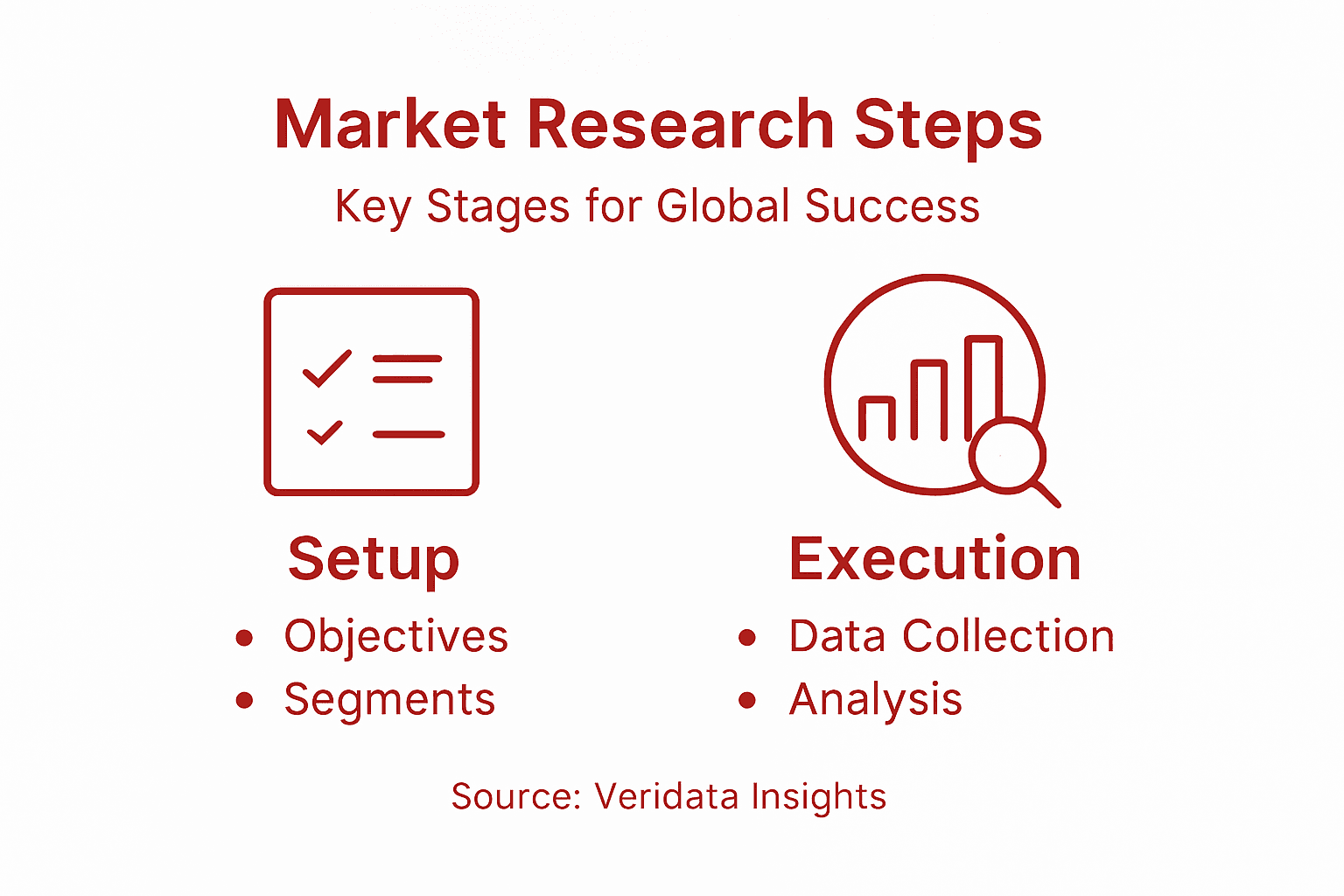
- Step 1: Define Research Objectives And Target Markets
- Step 2: Design Data Collection Strategies And Methodologies
- Step 3: Gather And Analyze Primary And Secondary Data
- Step 4: Interpret Insights To Inform Business Decisions
- Step 5: Validate Findings To Ensure Accuracy And Reliability
Quick Summary
| Key Point | Explanation |
|---|---|
| 1. Define clear research objectives | Articulate specific questions your organization needs answered to guide your research effectively. |
| 2. Identify specific target markets | Segment customers based on demographics and behaviors to focus research on relevant audiences. |
| 3. Match data collection strategies to objectives | Choose appropriate methodologies to ensure data quality and relevance based on your research needs. |
| 4. Analyze both primary and secondary data | Collect and assess original and existing information to gain comprehensive insights that validate your findings. |
| 5. Validate insights before presentation | Test conclusions against reality and participant feedback to ensure accuracy and reliability of research findings. |
Step 1: Define research objectives and target markets
Before you launch into data collection, you need clarity on what you’re actually trying to accomplish. This step sets the foundation for everything that follows. Without clear research objectives and well-defined target markets, your efforts scatter across too many directions, wasting resources and producing conflicting insights.
Start by articulating your research objectives with precision. What specific questions does your organization need answered? Are you exploring market entry opportunities in a new region? Testing product demand? Understanding customer satisfaction? Your objectives should be concrete enough that someone reading them instantly understands what success looks like. Vague goals like “understand the market better” won’t guide your research design or help your team know when they’ve found what they need.
Next, identify your target markets. This is where many organizations make critical mistakes by conflating broad market segments with the actual subset of customers who will purchase. Target markets are identified by segmenting customer groups based on relevant demographic and behavioral characteristics. You might be selling to North American manufacturers overall, but your actual target market could be mid-sized manufacturing companies in specific industries with annual revenues between 50 million and 500 million dollars. That specificity matters tremendously.
Here’s the practical part. Write down your research objectives as numbered statements. Then create a profile of your target market that includes geography, industry, company size, and any behavioral traits that matter. Distinguish between your broader addressable market and the specific segment you’re actually targeting first. This clarity prevents your research from becoming a fishing expedition and ensures your team collects relevant data.
Pro tip: _Align your research objectives with specific business decisions your leadership team needs to make within the next 90 days. Research that ties directly to a real decision gets used and influences strategy far more effectively than academic exercises.
Step 2: Design data collection strategies and methodologies
With your research objectives and target markets clearly defined, you now need to determine how you’ll actually gather the data. Your methodology choice directly impacts the quality and relevance of insights you’ll receive. The wrong approach wastes time and money. The right approach delivers actionable intelligence.
Start by matching your data collection method to your research questions. Market studies employ various information collection and analytical methodologies selected based on your specific objectives and market context. If you need to understand customer motivations and decision processes, qualitative methods like interviews and focus groups reveal the “why” behind behavior. If you need statistical validation across a large population, surveys and quantitative analysis provide scale and measurability. Most global research programs use both approaches together.
Consider your constraints realistically. Do you have budget for in-depth interviews across multiple countries, or should you prioritize online surveys that reach more respondents efficiently? How much time can you invest before leadership needs answers? What languages will you need to support? Your target market’s geography and accessibility directly influence which methods are practical. European manufacturing executives might engage in phone interviews readily, while others prefer online questionnaires.
Design your data collection process with quality built in from the start. Surveys, experiments, observations, focus groups, and interviews each have specific strengths and limitations. Document exactly how you’ll conduct each method, who will administer it, and how you’ll ensure consistency across regions. This structured approach prevents inconsistencies that undermine your analysis later.
Pro tip: _Run a small pilot test of your data collection approach with 20 to 30 respondents in your target market before full rollout. This catches questionnaire ambiguities, language issues, and process problems before they corrupt your entire dataset.
Step 3: Gather and analyze primary and secondary data
Now comes the execution phase. You’ll be collecting two types of data: original information you gather directly from your target market, and existing information already published or compiled by others. Both matter. Understanding the difference between them and how to analyze each properly determines whether your research produces reliable insights.
Start with primary data collection. This is information you gather directly through your chosen methodology. Interviews, surveys, and focus groups with your target market generate primary data tailored specifically to your research questions. Data collection is fundamental for statistical investigation and involves both primary and secondary sources. As responses come in, organize them systematically. Create templates or spreadsheets to record answers consistently. If you’re conducting interviews, transcribe them accurately. If you’re running surveys, input responses into a database where you can sort and filter the information.

Secondary data complements your primary findings. Industry reports, government statistics, competitor analyses, and academic studies provide broader context and validation. A survey showing that 67 percent of your target market prefers online purchasing becomes much more meaningful when you compare it against industry benchmarks showing 52 percent adoption across the sector. Secondary data fills gaps your primary research cannot address and helps you avoid costly mistakes.
Here’s a quick comparison of primary and secondary data types to guide effective research planning:
| Data Type | Source Example | Key Strength | Limitation |
|---|---|---|---|
| Primary Data | Customer interviews | Directly tailored insights | Time and cost intensive |
| Secondary Data | Industry reports | Broader context provided | May lack specific relevancy |
| Primary Data | Online surveys | Fast quantitative feedback | Risk of respondent bias |
| Secondary Data | Government statistics | Established benchmarks | May be outdated or generic |
Analyze your primary data with clear categorization. Analyzing primary data requires categorizing responses and coding qualitative answers using spreadsheets or statistical software. For qualitative information from interviews, identify common themes and patterns. For survey data, calculate percentages, averages, and correlations. Cross reference findings across both data types to strengthen your conclusions. When multiple sources point toward the same insight, your confidence in that finding increases significantly.
Pro tip: _Use triangulation by combining primary data from surveys with secondary industry reports and primary qualitative interviews. When all three sources align on the same conclusion, your leadership team gains confidence in acting on your recommendations.
Step 4: Interpret insights to inform business decisions
You now have raw data organized and analyzed. The next challenge is translating those findings into insights that actually change how your organization makes decisions. Raw data sitting in spreadsheets helps no one. Insights that guide strategy change everything.
Start by looking for patterns that reveal something unexpected. Market analysis provides vital insights to support strategic business decisions across various stages including market entry, strategic planning, product development, and competitive positioning. Not every finding is equally important. A survey showing that 72 percent of respondents prefer email communication is useful information. But discovering that those who use email also have 40 percent higher lifetime value than those who prefer phone calls is an insight that changes how you allocate resources.
Context transforms data into meaning. Your numbers need a story attached. Why did adoption rates drop in the German market when they stayed flat elsewhere? Is it a regulatory issue, a competitive threat, or a messaging problem? Dig into the “why” behind your numbers. Compare results across demographics, geographies, and customer segments. When you explain not just what happened but why it happened, your leadership team can act with confidence.
Connect insights directly to business decisions your organization faces right now. True marketing insights go beyond data aggregation to reveal novel, non-obvious understandings that change decision-making perspectives. If your company is deciding whether to enter a new market, present findings that directly address that choice. Show market size, competitive intensity, customer readiness, and regulatory barriers. Frame each insight around the specific decision your stakeholders must make. Avoid creating research that looks impressive but doesn’t influence action.
Validate your interpretation by testing it against business reality. Ask yourself: Do these insights contradict what we already know, or do they confirm and extend it? Would a reasonable person looking at this data reach the same conclusions I did? Have you eliminated simpler explanations before accepting complex ones? This mental discipline prevents overconfidence in findings that might not hold up under scrutiny.
Below is a summary of how insight interpretation can influence business strategy:
| Step in Insight Process | Main Activity | Strategic Value |
|---|---|---|
| Pattern Identification | Spotting trends and anomalies | Reveals hidden opportunities/threats |
| Adding Context | Explaining the “why” | Supports accurate decision-making |
| Connecting to Decisions | Aligning with business needs | Ensures actionable recommendations |
| Validation | Testing against reality | Increases stakeholder confidence |
Pro tip: _Present insights using the “so what” framework: state the finding, explain why it matters to the business, and recommend one clear action. This structure forces you to move beyond interesting data points to actual decision support that executives can use immediately.
Step 5: Validate findings to ensure accuracy and reliability
Before you present findings to leadership, you need confidence that your conclusions actually hold up under scrutiny. Validation separates credible research from flawed analysis that leads organizations down costly wrong paths. This step protects your reputation and ensures your insights drive sound decisions.
Start by examining your research instruments themselves. Establishing the validity of survey research involves rigorous pretesting, cognitive interviews, and iterative refinement of instruments. Did your survey questions actually measure what you intended them to measure? Run a small pilot test with 20 to 30 respondents before full deployment. Listen for confusion in how people interpret your questions. Watch for ambiguous wording that could be answered multiple ways. Refine questions based on what you learn. This upfront investment prevents you from collecting thousands of invalid responses that undermine your entire analysis.
Validate your data by checking for internal consistency. Look for contradictions within individual responses. If someone says they use your product daily but later claims they have never purchased it, something went wrong during data collection or entry. Run frequency distributions to spot outliers and anomalies. Compare response patterns across similar respondent groups. When subgroups that should behave similarly show wildly different results, investigate why before accepting the data as valid.
Bring your findings back to the people who provided the data. Validating research findings by sharing and discussing data with participants transforms them into trusted partners, enhancing accuracy and relevance. Schedule follow-up conversations with a subset of interview participants or survey respondents. Share your preliminary conclusions and ask whether your interpretation rings true from their perspective. This member checking process catches misunderstandings and strengthens the authenticity of your findings. Participants often provide context you missed during analysis.
Test your conclusions against competing explanations. Could different factors explain the patterns you discovered? Have you eliminated simpler explanations before accepting complex ones? Ask skeptical colleagues to poke holes in your logic. Build a convincing case that your interpretation is the most plausible one given the evidence.
Pro tip: _Document every assumption and decision you made during analysis. When someone later questions your methodology, you can explain exactly how you arrived at your conclusions and defend the validity of your approach.
Master Your Global Market Research with Expert Data Collection Solutions
Conducting market research for global success involves overcoming complex challenges like defining precise research objectives, selecting the right data collection methodologies, and validating findings to ensure reliability. Feeling overwhelmed by these critical steps and the need to collect accurate insights from diverse geographic regions is common. You want to move beyond vague data and deliver actionable intelligence that drives confident business decisions.
At Veridata Insights you gain access to proven expertise in global data collection and market research designed to address these exact pain points. Our solutions help you clearly define target markets, implement rigorous quality controls during data gathering, and validate findings to protect your investment. Whether you need tailored qualitative interviews or large-scale surveys across multiple countries our team supports every step to ensure your research is precise and impactful.
Ready to turn your market research challenges into clear competitive advantages
Explore how our global solutions can transform your approach by connecting with Veridata Insights. Start by defining your research objectives with clarity through our expert guidance then leverage our proven methodologies to capture relevant primary and secondary data. Don’t wait until gaps undermine your business decisions engage now with Veridata Insights and make confident strategic moves in your global markets.
Frequently Asked Questions
What are the key steps to conducting market research for global success?
To conduct market research effectively, start by defining your research objectives and target markets. Then, design your data collection strategies, gather both primary and secondary data, analyze the insights, and validate your findings to ensure accuracy and reliability.
How do I define my target markets for international research?
Define your target markets by segmenting potential customers based on specific demographics and behaviors. Create a detailed profile including factors like geography, industry, and company size to focus your research efforts accurately.
What methods should I use to gather data for my market research?
Use a combination of qualitative and quantitative methods to gather comprehensive data. For example, conduct interviews for deeper insights and surveys for statistical validation to enhance the reliability of your findings.
How can I ensure the insights I obtain from market research influence business decisions?
Connect your research insights directly to actionable business decisions by framing them around specific choices your organization needs to make. Present findings using a clear structure that states the discovery, its importance, and a recommended action.
Why is it important to validate my market research findings?
Validating your findings ensures the insights are accurate and reliable, which protects your organization’s reputation and guides better decision-making. Implement checks such as obtaining feedback from respondents and comparing results against expectations to confirm your conclusions.
Recommended
- Go-to-Market Strategy Development – Veridata Insights
- How to Ensure Accurate Market Research in Volatile or Emerging Markets – Veridata Insights
- The Market Research Process Simplified for Consulting Teams – Veridata Insights
- B2B and B2C Marketing Research And Why You Should Use Veridata Insights – Veridata Insights