



Contrary to popular belief, full service market research doesn’t mean relinquishing control of your project to a vendor. True full service is a flexible, collaborative partnership where you stay actively involved at every stage, from initial consultation through final reporting. This guide clarifies what full service market research truly involves, how it integrates qualitative and quantitative methodologies, and how consultants can confidently commission research that delivers actionable insights tailored to their unique business objectives.
Table of Contents
- Understanding Full Service Market Research
- Key Phases And Methodologies In Full Service Research
- Common Misconceptions About Full Service Market Research
- Comparing Full Service To Partial And DIY Market Research Approaches
- Technological Integration And Innovations In Full Service Market Research
- Real World Applications And Case Studies
- Implementing Full Service Market Research In Consultancy Projects
- Partner With Veridata Insights For Full Service Market Research
- Frequently Asked Questions
Key takeaways
| Point | Details |
|---|---|
| Comprehensive integration | Full service market research covers consultation, design, recruitment, data collection, processing, and reporting with expert methodology at every phase. |
| Dual methodology strength | Combines qualitative and quantitative methods for robust, actionable insights that address complex business questions. |
| Active collaboration | Clients choose flexible service levels and remain engaged throughout, ensuring alignment with strategic goals. |
| Superior quality control | Compared to partial or DIY approaches, full service offers specialized recruitment, advanced analytics, and comprehensive oversight. |
| Technology enhanced | AI and automation improve speed, accuracy, and depth of analysis, delivering faster turnaround without sacrificing quality. |
Understanding full service market research
Full service market research encompasses every phase of the research lifecycle: consultation and design, methodology selection, questionnaire review, programming, data collection, data processing and coding, and reporting with analytics and data visualization. This integrated approach bridges methodological rigor with practical application, ensuring insights directly support your strategic decisions.
Unlike fragmented research models, full service market research explained combines both qualitative and quantitative methods within a single project framework. You might conduct focus groups to explore consumer attitudes, then validate findings with a quantitative survey across a broader sample. This dual methodology approach delivers depth and scale simultaneously.
Clients retain active involvement through collaborative touchpoints at each phase. You define objectives during consultation, approve research instruments before fielding, and review preliminary findings to ensure alignment. This partnership model means you maintain strategic control while leveraging specialized expertise for execution.
Key components of full service market research include:
- Consultation to align research goals with business objectives and define success metrics
- Custom methodology design balancing qualitative depth with quantitative breadth
- Expert recruitment targeting specialized segments, including hard to reach audiences
- Rigorous data collection protocols ensuring sample quality and response integrity
- Advanced processing and coding to transform raw data into structured insights
- Comprehensive reporting with visualization tools that translate findings into actionable recommendations
When choosing a full service research agency, evaluate their methodology expertise, recruitment capabilities, and technology infrastructure. Top full service market research companies demonstrate proven success across diverse industries and audience types.

Key phases and methodologies in full service research
Full service research progresses through six core phases, each requiring specialized expertise and quality controls. Understanding these phases helps you engage effectively and maximize project value.
- Consultation and goal alignment: Research teams work with you to translate business questions into researchable objectives. This phase establishes success criteria, timeline expectations, and budget parameters.
- Study design and methodology selection: Researchers recommend optimal methods based on your objectives. Full service research solutions combining methodologies integrate approaches like ethnography, in depth interviews, online surveys, and conjoint analysis within unified project frameworks.
- Recruitment and sample development: Expert recruiters identify and screen participants matching precise demographic, behavioral, or professional criteria. This phase proves especially critical for B2B, healthcare, and niche audiences where standard panels fall short.
- Data collection and fieldwork: Whether conducting qualitative sessions or quantitative surveys, full service providers manage participant engagement, quality assurance, and real time monitoring to ensure data integrity.
- Data processing and analysis: Raw data undergoes cleaning, coding, and validation before analysis. Advanced statistical techniques and qualitative coding frameworks transform responses into meaningful patterns and insights.
- Reporting and visualization: Final deliverables translate findings into executive summaries, detailed reports, and interactive dashboards that support decision making across stakeholder groups.
Pro Tip: Request interim check ins after recruitment and initial data collection to catch any sample or response quality issues early, before they compromise final results.
Qualitative components explore the “why” behind behaviors through methods detailed in qualitative market research FAQs, while quantitative components measure prevalence and statistical relationships. Integrating both within full service projects delivers comprehensive understanding that neither method achieves alone.
Common misconceptions about full service market research
Several persistent myths prevent consultants from fully leveraging full service research capabilities. Clarifying these misconceptions helps you engage more effectively and extract greater value.
Full service does not mean complete vendor control. You remain actively involved through structured collaboration points: approving research designs, reviewing instruments, monitoring fieldwork progress, and validating preliminary findings. The “full” refers to comprehensive service offerings, not vendor autonomy.
Another misconception assumes full service requires using every available service component. In reality, flexible engagement models let you select specific phases based on internal capabilities and project needs. You might handle study design internally while outsourcing specialized recruitment and data processing.
Key clarifications include:
- Full service partnerships maintain client strategic control while delegating tactical execution
- Service scope adapts to project complexity, budget constraints, and timeline requirements
- You choose collaboration intensity, from hands off to deeply embedded oversight
- Methodological recommendations remain advisory, with final decisions resting with you
- Transparent communication ensures alignment throughout the project lifecycle
Some believe full service market research explained only suits large enterprises with substantial budgets. Modern full service providers offer scalable solutions with no project minimums, making comprehensive research accessible to consultancies of all sizes.
Understanding these realities transforms full service from a black box vendor relationship into a strategic capability that enhances your consultancy’s research outcomes and client deliverables.
Comparing full service to partial and DIY market research approaches
Choosing between full service, partial support, and do it yourself research requires evaluating trade offs across quality, cost, expertise, and risk dimensions.
| Aspect | Full Service | Partial Service | DIY Research |
|---|---|---|---|
| Methodology expertise | Comprehensive, multi method integration | Limited to specific phases or methods | Depends on internal capabilities |
| Quality control | End to end oversight with validation | Gaps between service boundaries | Self managed, variable rigor |
| Recruitment capability | Specialized panels and custom recruitment | Standard panels, limited customization | Convenience samples, high bias risk |
| Data processing | Advanced analytics and visualization | Basic processing, limited depth | Manual analysis, error prone |
| Timeline efficiency | Optimized through specialized resources | Moderate, depends on coordination | Extended, learning curve delays |
| Cost structure | Higher upfront, lower risk of rework | Moderate, hidden coordination costs | Lower direct costs, high opportunity costs |
Full service research delivers comprehensive quality through integrated methodology, expert recruitment reaching specialized audiences, and advanced analytics that surface deeper insights. These advantages prove especially valuable for complex consultancy projects where methodological gaps or sampling errors undermine strategic recommendations.
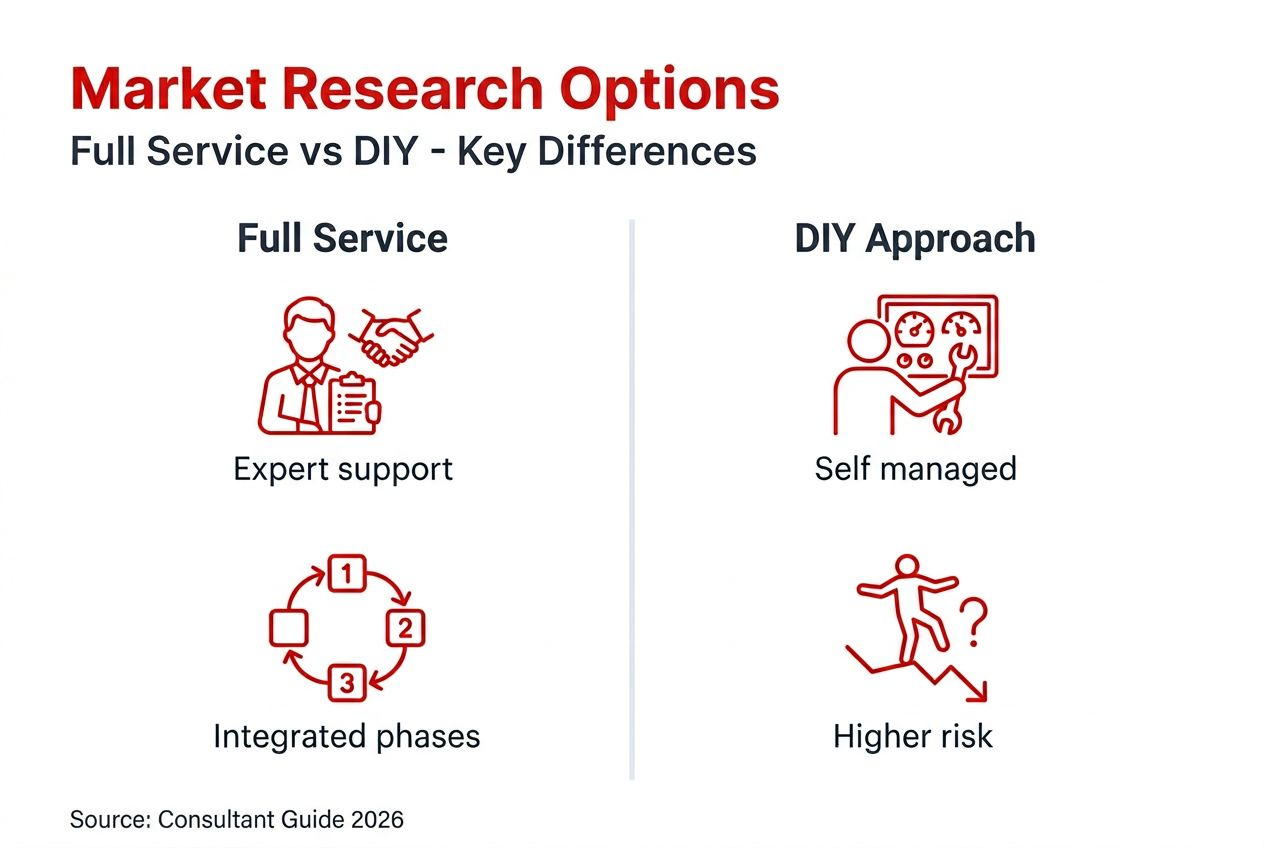
Partial approaches reduce immediate costs but introduce coordination challenges and quality gaps between self managed and outsourced phases. You might design a strong questionnaire but struggle with recruitment, or collect quality data but lack analytical tools to extract full value.
DIY research appeals when budgets constrain options, but carries substantial risks. Without methodological training, consultants often introduce unintentional bias through leading questions, convenience sampling, or flawed analysis techniques. These errors compound, producing unreliable findings that misdirect strategic decisions.
Pro Tip: Calculate total project costs including your time investment and opportunity costs, not just vendor fees, to accurately compare approaches and identify the most cost effective solution.
Full service research supports better strategic decision making by reducing methodological errors, providing fuller insights through integrated methods, and delivering analysis depth that surfaces actionable patterns invisible to simpler approaches.
Technological integration and innovations in full service market research
Emerging technologies fundamentally enhance full service research capabilities, improving accuracy, speed, and analytical depth while maintaining human expertise for strategic interpretation.
AI assisted survey programming minimizes instrument errors by automatically detecting question logic flaws, identifying confusing wording, and suggesting improvements based on best practice databases. These tools catch issues human reviewers might miss, strengthening data quality from the start.
Key technological advances transforming full service research include:
- Automated data processing that accelerates cleaning, coding, and validation while reducing manual errors
- Machine learning algorithms identifying complex patterns and segment structures within large datasets
- Natural language processing extracting themes and sentiment from open ended responses at scale
- Real time dashboards enabling you to monitor fieldwork progress and preliminary results as data arrives
- Advanced visualization platforms translating statistical findings into interactive charts, maps, and decision tools
- Integration APIs connecting research data with your CRM, analytics, and business intelligence systems
These innovations enable flexible customization previously requiring prohibitive manual effort. You can test multiple questionnaire versions simultaneously through adaptive survey logic, or analyze subgroup differences across dozens of demographic combinations without extended processing delays.
Technology also supports greater data integrity through automated validation checks, duplicate response detection, and quality scoring algorithms that flag suspicious patterns for human review. This layered approach combines computational efficiency with expert judgment.
Importantly, technology enhances rather than replaces human expertise in full service research. Strategic research design, nuanced qualitative interpretation, and actionable recommendation development still require experienced researchers who understand your business context and strategic objectives.
Real world applications and case studies
Full service market research proves especially valuable in complex sectors like healthcare and B2B consultancy, where specialized recruitment and integrated methodologies unlock insights inaccessible through simpler approaches.
Healthcare consulting benefits from dual method strategies that capture both patient experiences and provider perspectives. A typical project might combine patient focus groups exploring treatment decision factors with a quantitative physician survey measuring adoption barriers. This integration reveals how patient preferences and clinical considerations interact, informing more effective intervention strategies.
Strategic decision accuracy improved by 25% in documented healthcare consulting cases using full service research compared to limited research approaches. These gains stem from nuanced insights about patient and provider motivations that single method studies miss.
B2B sector applications leverage expert recruitment capabilities to reach elusive decision maker populations. Standard panels rarely include procurement directors, C suite executives, or specialized technical buyers. Full service providers use multi touch recruitment strategies, professional networks, and incentive optimization to achieve response rates exceeding 30% among these difficult audiences.
Real world success factors include:
- Custom recruitment strategies tailored to specific professional segments and seniority levels
- Methodology integration addressing both exploratory and confirmatory research objectives
- Collaborative client involvement ensuring research aligns with evolving strategic priorities
- Advanced analytics surfacing opportunity areas and competitive vulnerabilities within market landscapes
Consultants using market research in consulting decision making report that full service approaches deliver richer context, stronger evidence bases, and more defensible recommendations compared to limited research alternatives.
These applications demonstrate how full service research enhances insight quality and business impact across diverse consultancy contexts, from market entry strategies to product development validation.
Implementing full service market research in consultancy projects
Successfully commissioning full service research requires clear planning, active collaboration, and strategic engagement throughout the project lifecycle.
- Establish clear objectives and success criteria: Define specific business questions, decision contexts, and how research findings will inform client recommendations before engaging providers.
- Select providers with relevant expertise: Evaluate methodology capabilities, industry experience, and recruitment specialization matching your project needs when choosing a full service research agency.
- Structure communication and collaboration touchpoints: Schedule regular check ins at key project milestones: design approval, recruitment completion, fieldwork midpoint, and preliminary findings review.
- Leverage flexible service offerings: Customize engagement scope based on internal capabilities, budget constraints, and timeline requirements rather than defaulting to standard packages.
- Align recruitment strategies with audience specifics: Work with providers to define precise screening criteria, especially for specialized B2B segments requiring customized survey design for B2B or techniques to recruit hard to reach audiences.
- Engage actively in instrument review: Provide feedback on questionnaires and discussion guides to ensure language, concepts, and question flow align with industry terminology and client contexts.
- Request interim results and preliminary findings: Review initial data patterns before final analysis to identify opportunities for deeper exploration or clarification.
- Utilize detailed reporting and visualization: Leverage interactive dashboards and visual analytics to communicate findings effectively to your clients and internal stakeholders.
Pro Tip: Build a project brief documenting objectives, target audiences, methodology preferences, and timeline constraints before initial provider conversations to accelerate proposal development and ensure alignment from the start.
Effective implementation transforms full service research from a vendor transaction into a strategic capability that strengthens your consultancy’s analytical rigor, insight depth, and client value delivery.
Partner with Veridata Insights for full service market research
Veridata Insights delivers comprehensive market research solutions integrating expert methodologies, cutting edge technology, and flexible collaboration models tailored to consultancy needs. Our full service approach covers consultation and design, methodology selection, questionnaire development, programming, data collection, processing and coding, and reporting with advanced analytics and visualization.
Whether you need complete end to end support or targeted assistance with specialized recruitment and data processing, our flexible service model adapts to your project scope and budget. We excel at reaching hard to reach B2B, healthcare, and specialized audiences that standard research approaches miss.
Our collaborative partnership ensures your strategic vision guides every project phase while our methodological expertise delivers actionable insights that strengthen client recommendations. Contact Veridata Insights to discuss how full service research can elevate your consultancy’s market intelligence capabilities.
Frequently asked questions
What does full service market research include?
Full service market research encompasses consultation and goal setting, study design and methodology selection, participant recruitment, data collection and fieldwork, data processing and coding, and comprehensive analysis with reporting and visualization. This integrated approach ensures quality control and methodological rigor across the entire research lifecycle, delivering actionable insights aligned with your strategic objectives.
How is full service research different from partial or DIY approaches?
Full service offers end to end expertise, integrated quality control, and seamless methodology coordination that partial and DIY approaches cannot match. Partial services create gaps between self managed and outsourced phases, while DIY research often introduces unintentional bias and methodological errors. Full service providers bring specialized recruitment capabilities, advanced analytical tools, and experienced researchers who ensure reliable, defensible findings. Learn more about these distinctions at full service market research explained.
Can clients choose which parts of full service research to use?
Yes, full service providers offer flexible engagement models allowing you to select specific phases based on internal capabilities and project requirements. You might handle study design internally while outsourcing specialized recruitment and data processing, or engage providers only for advanced analytics and reporting. This modular approach lets you optimize resource allocation while still accessing expert capabilities where they add most value.
What are common challenges in full service research?
Key challenges include maintaining active client involvement throughout longer project timelines, recruiting specialized or hard to reach sample populations, coordinating across multiple methodologies and data sources, ensuring thorough data quality control with large datasets, and translating complex findings into accessible recommendations for diverse stakeholder audiences. Experienced full service providers mitigate these challenges through structured communication protocols, expert recruitment networks, and proven project management frameworks.
How do new technologies improve full service research?
AI and automation reduce human errors in survey programming and data processing, accelerate turnaround times through automated cleaning and coding, and enhance analytical depth by identifying complex patterns within large datasets. Real time dashboards enable continuous monitoring and faster decision making, while advanced visualization tools make findings more accessible and actionable. These technologies complement rather than replace human expertise, combining computational efficiency with strategic interpretation to deliver superior research outcomes.