

TL;DR:
- Consumer insights reveal why consumers behave as they do, enabling businesses to make strategic decisions.
- Unlike raw data, insights directly inform actions to improve marketing, product development, and customer experiences.
Consumer insights are the actionable interpretations of data that reveal why consumers behave the way they do, not just what they do. Businesses that prioritize this discipline grow 2.5 times faster than competitors who rely on raw data alone. Platforms like GWI, Brandwatch, and Meltwater have built entire product lines around the premise that understanding motivation is more valuable than tracking behavior. This guide explains what consumer insights are, how they differ from market research, which methods actually work, and how organizations use them to drive measurable growth.
What are consumer insights and why do they matter?
Consumer insights are defined as meaningful, evidence-based understandings of the motivations, needs, and behaviors that drive customer decisions. The industry term you will encounter most often is “consumer intelligence,” though “consumer insights” is the widely accepted working term across marketing, product, and strategy functions.

The critical distinction is this: a data point tells you what happened. An insight tells you why it happened and what to do about it. A sales report showing a 10% revenue drop is data. The insight is discovering that a competitor’s rebranding shifted your brand perception among 25 to 34-year-olds, which is what actually caused the drop. That shift in understanding changes what a business decides to do, which is the only real test of whether you have an insight at all.
For decision-makers, this matters because the gap between data and insight is where most strategic mistakes live. Teams that stop at dashboards and reports make decisions based on symptoms. Teams that pursue genuine consumer understanding make decisions based on causes.
What are the key types of consumer insights?
Consumer insights fall into six distinct categories, each drawing from different data sources and answering different strategic questions.
Behavioral insights come from purchase histories, web analytics platforms like Google Analytics 4, and CRM data. They answer questions like: what do customers buy, when, and in what sequence? These are the most widely collected insights but also the most misread, because behavior without context is just pattern recognition.
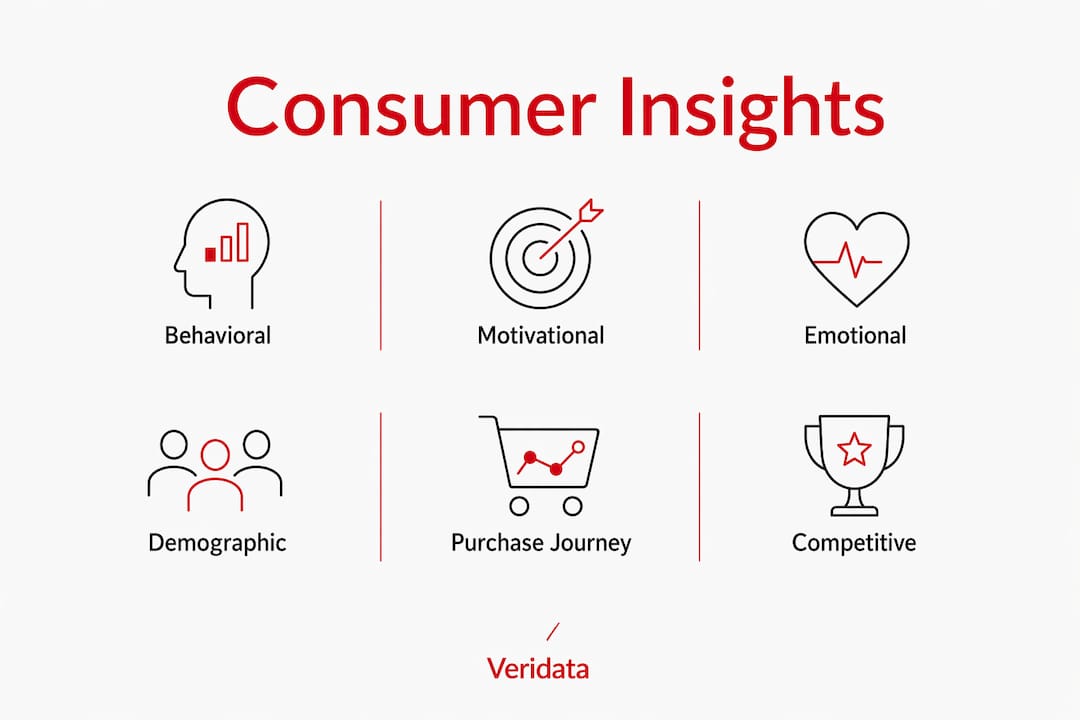
Motivational insights dig into the “why” behind purchases. They typically come from in-depth interviews, focus groups, and open-ended survey responses. A consumer who buys a premium mattress is not just buying sleep. They may be managing anxiety, signaling status, or responding to a health scare. Knowing the motivation changes how you market the product entirely.
Emotional insights are captured through social listening tools like Brandwatch and Meltwater, which analyze unprompted conversations across social media, forums, and review platforms. These signals are often more honest than survey responses because consumers are not performing for a researcher.
Demographic insights use survey data, census records, and panel research to segment audiences by age, income, geography, and lifestyle. A well-known example: Gen Z engages twice as much with sustainability messaging compared to Gen X, a finding that has reshaped product positioning across consumer goods categories.
Purchase journey insights map the full path from awareness to conversion, identifying where consumers drop off and why. Cart abandonment analysis is a classic application here. Knowing that 68% of carts are abandoned is data. Knowing that checkout friction caused by mandatory account creation is the primary trigger is an insight.
Competitive insights benchmark your brand perception against rivals using share-of-voice analysis, review sentiment, and net promoter score comparisons.
| Insight type | Primary data source | Business application |
|---|---|---|
| Behavioral | Web analytics, CRM, purchase data | Conversion optimization, retention |
| Motivational | Interviews, focus groups, surveys | Messaging strategy, product positioning |
| Emotional | Social listening, review analysis | Brand health, crisis management |
| Demographic | Surveys, census, panel data | Audience segmentation, targeting |
| Purchase journey | Funnel analytics, session recordings | UX improvement, cart recovery |
| Competitive | Share-of-voice, NPS benchmarks | Positioning, differentiation |
How do consumer insights differ from market research?
Market research is the process of collecting data about a market, its size, competitors, and customer demographics. Consumer insights are what you extract from that process when you ask the right questions. The two are related but not interchangeable, and confusing them is expensive.
Think of market research as the raw material and consumer insights as the finished product. A market research report might tell you that 60% of your customers are women aged 30 to 45 who shop online. That is useful context. The insight is understanding that those customers abandon your site at the shipping cost reveal because they perceive free shipping as a baseline expectation, not a perk. One finding describes your audience. The other tells you what to fix.
Leveraging market research effectively means applying an actionability test to every finding. Ask: does this change what we will do? If the answer is no, you have data. If the answer is yes, you have an insight.
| Category | Definition | Business value |
|---|---|---|
| Raw data | Unprocessed numbers and records | Baseline tracking |
| Market research | Structured data collection about a market | Context and sizing |
| Consumer insights | Actionable interpretation of why consumers behave as they do | Strategic decision-making |
Pro Tip: Before presenting any research finding to leadership, run the actionability test out loud. Say: “Because of this finding, we will change X.” If you cannot complete that sentence, keep digging.
Which methods effectively gather and analyze consumer insights?
The strongest consumer insights programs combine qualitative and quantitative sources rather than relying on any single method. Here is how the main approaches stack up.
Surveys remain the most scalable method for quantitative data. They work best when questions are specific, response scales are consistent, and sample sizes are large enough to segment by persona. The weakness is social desirability bias: people answer how they think they should, not always how they actually behave.
Focus groups and in-depth interviews surface motivational and emotional insights that surveys miss. A 60-minute interview with eight customers can reveal product frustrations that six months of analytics never flagged. The trade-off is cost and scale.
Social listening is where modern consumer insights programs have the clearest edge. Unprompted social conversations provide a more honest signal than traditional surveys because consumers are not performing for a researcher. Tools like Brandwatch and Hootsuite, powered by Talkwalker, analyze millions of online sources with AI for sentiment and trend detection in real time.
Behavioral tracking through web analytics, heatmaps, and CRM platforms captures what consumers actually do rather than what they say they do. Combining this with qualitative data closes the gap between stated and revealed preferences.
AI-powered platforms now transform unstructured data from social media, reviews, and forums into structured market intelligence at a speed no human analyst team can match. The risk is treating AI output as insight without applying human interpretation to understand context and nuance.
- Surveys: high scale, risk of bias, best for quantitative segmentation
- Interviews and focus groups: deep motivation, low scale, high cost
- Social listening: real-time, unprompted, best for emotional and trend insights
- Behavioral tracking: reveals actual behavior, requires qualitative context to interpret
- AI platforms: fast and broad, requires human interpretation layer
Pro Tip: Combining CRM, surveys, and social listening into a single segmentation model produces the most reliable consumer profiles. No single source is sufficient on its own.
How do organizations apply consumer insights to drive growth?
The strategic applications of consumer insights span every major business function. Here are the four highest-impact use cases.
- Product development. Consumer insights identify unmet needs before competitors do. IKEA’s expansion into small-space furniture was driven by insights showing urban consumers in markets like Tokyo and New York were not buying large furniture sets because of apartment size constraints, not price sensitivity. The insight changed the product line, not the pricing strategy.
- Marketing personalization. Companies using data-driven insights are 23 times more likely to acquire customers and six times more likely to retain them. That gap exists because personalized messaging based on real consumer motivations outperforms generic campaigns at every stage of the funnel. Coca-Cola’s “Share a Coke” campaign replaced its logo with popular names after insights revealed that personal recognition drove emotional connection with the brand more than product attributes did.
- Customer experience improvement. Insights from consumer insight analysis identify friction points in the customer journey that internal teams often cannot see because they are too close to their own processes. A financial services firm that discovers customers abandon loan applications at the income verification step has an insight. The fix might be a simpler upload interface or a phone-based alternative.
- Brand positioning. Competitive and cultural insights tell you where white space exists in your category. A brand that discovers its core audience associates it with reliability but not excitement has a positioning insight. That finding can inform everything from creative direction to partnership strategy.
“True consumer insights deliver a new perspective that inspires concrete changes in business strategy rather than just describing data.” — MixBright, 2026
Understanding shifting consumer preferences in real time is what separates organizations that lead their categories from those that react to them.
Key takeaways
Consumer insights are the single most direct path from data to strategic decisions that actually move business outcomes.
| Point | Details |
|---|---|
| Insights beat data | A true insight changes what a business decides to do, not just what it knows. |
| Six insight types exist | Behavioral, motivational, emotional, demographic, journey, and competitive insights each require different data sources. |
| Multi-source approach wins | Combining surveys, social listening, and behavioral data produces the most reliable consumer profiles. |
| Actionability is the test | If a finding does not change a business action, it is data, not an insight. |
| Growth is measurable | Insight-driven companies are 23 times more likely to acquire customers than those relying on raw data. |
What I have learned from years of watching companies misuse their own data
Here is the uncomfortable truth about consumer insights: most organizations collect far more data than they ever act on. I have seen companies invest heavily in research platforms, commission quarterly reports, and still make product decisions based on gut instinct because no one translated the findings into a clear recommendation.
The real challenge is not gathering data. It is building the internal habit of asking “so what?” after every finding. That question is where insights are born. A sales decline is not an insight. A sales decline caused by a specific friction point in the mobile checkout experience for first-time buyers aged 18 to 24 is an insight. One gives you a problem. The other gives you a solution.
Cross-functional collaboration is the other piece most teams underestimate. Consumer insights that live only in the marketing department never reach the product team, the customer service team, or the executives who set budget priorities. The organizations that get the most value from their research are the ones that treat insights as shared assets, not departmental property.
I am also watching the AI tools conversation with some caution. Platforms like Hootsuite powered by Talkwalker and AI-driven analytics tools are genuinely powerful for processing volume and detecting trends at scale. But AI surfaces patterns. Humans still need to interpret what those patterns mean for a specific brand, in a specific market, at a specific moment. The companies winning right now are the ones using AI to accelerate their research, not replace the thinking behind it.
How Veridata Insights helps you turn data into decisions
At Veridata Insights, our consultancy delivers the full research process so you can focus on acting on findings rather than managing them. From questionnaire design and methodology selection to data collection, coding, and analytics visualization, the team handles every stage with no project minimums and availability seven days a week. Whether you need quantitative surveys, qualitative focus groups, or a hybrid approach for B2B, B2C, healthcare, or hard-to-reach audiences, Veridata Insights builds the research program around your objective. If you are ready to move from data collection to genuine consumer understanding, start your research project with Veridata Insights today.
FAQ
What is the difference between consumer insights and market research?
Market research collects structured data about a market, its size, competitors, and demographics. Consumer insights are the actionable interpretations extracted from that data that explain why consumers behave as they do and what a business should do differently as a result.
How do you know if a finding is a true consumer insight?
Apply the actionability test: if the finding does not cause a change in business strategy, messaging, or product direction, it is data, not an insight. A true insight always leads to a concrete decision.
What methods are most effective for gathering consumer insights?
The strongest programs combine surveys for scale, in-depth interviews for motivation, and social listening for unprompted emotional signals. Combining CRM, behavioral tracking, and social data produces the most reliable consumer profiles.
Why are consumer insights important for business growth?
Companies using data-driven insights are 23 times more likely to acquire customers and six times more likely to retain them. Insights allow businesses to address real consumer needs rather than assumed ones, which improves every stage of the customer funnel.
What tools do companies use to analyze consumer insights?
Leading platforms include Brandwatch and Meltwater for social listening, GWI for audience intelligence, and Hootsuite powered by Talkwalker for AI-driven sentiment and trend analysis across millions of online sources.
Recommended
- Consumer Research for Business Professionals: 2026 Guide
- How Market Research Drives Strategic Decision-Making in Consulting – Veridata Insights
- Master the business consultant research process: clear decisions
- Consumer Insights for Education: Driving Smarter Decisions in a Changing Landscape – Veridata Insights