



TL;DR:
- Structured, goal-driven workflows enhance insight speed and reliability in 2026.
- Building data quality, governance, and continuous improvement are essential for long-term success.
- Organizational culture and ownership are critical to scaling data analysis value beyond tools.
Your data analysis workflow is either your competitive edge or your biggest bottleneck. In 2026, marketing and research professionals who rely on fragmented, manual, or ad-hoc processes are leaving serious ROI on the table. The gap between teams that generate fast, reliable insights and those drowning in spreadsheets comes down to one thing: workflow design. This guide walks you through a structured, scalable, and AI-ready framework, from preparation to continuous improvement, so you can make smarter decisions, faster. Whether you are refining an existing process or building from scratch, you will leave with a clear, actionable roadmap.
Table of Contents
- Essential pillars of the 2026 data analysis workflow
- How to set up your workflow: Preparation and requirements
- Executing the modern workflow: Integration, AI, and automation
- Verification and continuous improvement: Governance, KPIs, and the ROI loop
- What most data analysis guides miss in 2026
- Next steps: Enhance your data workflow with expert support
- Frequently asked questions
Key Takeaways
| Point | Details |
|---|---|
| Use the 6 pillars | Build your workflow on a structured framework to tackle any marketing or research analysis project in 2026. |
| Prioritize quality and KPIs | Focus on data quality, multi-touch attribution, and the right KPIs to drive impactful decisions. |
| Embrace AI and automation | Integrate AI and automated tools for substantial ROI and efficiency gains in your workflow. |
| Iterate and verify | Your workflow should include continuous audits, KPI reviews, and improvement cycles for lasting success. |
Essential pillars of the 2026 data analysis workflow
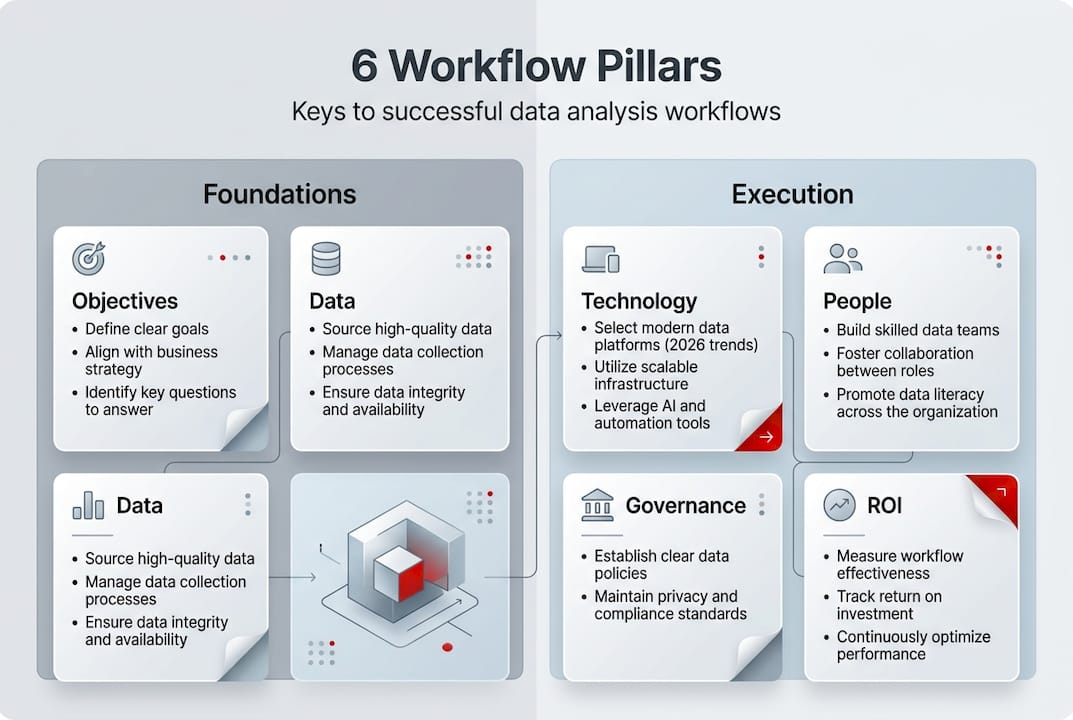
Every effective data analysis workflow starts with structure. Without it, even the best tools and talent produce inconsistent results. The 6-Pillar Framework gives your workflow a clear spine, connecting strategy to execution at every stage.
Here are the six pillars every modern workflow should include:
- Business objectives: Start with the question, not the data. Every workflow decision should trace back to a defined business goal.
- Data and architecture: Know where your data lives, how it flows, and whether it is trustworthy before you analyze anything.
- Tools and technology: Select platforms that integrate well and scale with your needs, not just the ones with the best marketing.
- People and skills: Assign clear roles. Analysts, data engineers, and stakeholders all need to know their lane.
- Governance and integrity: Build in quality checks, access controls, and documentation from day one.
- KPIs and ROI: Define success metrics upfront so you can measure what actually matters.
This framework is a significant shift from traditional approaches, which often started with available data rather than business questions. A step-by-step data analysis process anchored to these pillars keeps teams aligned and prevents scope creep.
Here is how the 2026 approach compares to older workflows:
| Dimension | Traditional workflow | 2026 pillar-based workflow |
|---|---|---|
| Starting point | Available data | Business question |
| Technology selection | Tool-first | Objective-first |
| Governance | Reactive | Built-in from day one |
| Success measurement | Output volume | ROI and KPI outcomes |
| Team alignment | Siloed | Cross-functional by design |
| Scalability | Limited | Designed for growth |
The question-first approach changes everything. When your team knows why they are analyzing data before they touch it, the entire workflow becomes more focused and more valuable. Phased pilots and organizational alignment are not optional extras in 2026. They are foundational.
How to set up your workflow: Preparation and requirements
Knowing the pillars is one thing. Building the actual infrastructure is another. Preparation is where most workflows either gain momentum or stall out. Here is a numbered setup process that works.
- Define your business questions. Write them down explicitly. Vague questions produce vague insights.
- Assemble your stakeholders. Include marketing, research, IT, and leadership early. Misalignment at this stage is expensive later.
- Inventory your data sources. List every data source your team currently uses, including CRMs, survey platforms, ad platforms, and third-party feeds.
- Audit data quality. Check for completeness, accuracy, and consistency before building any analysis layer on top.
- Secure your data sources. Confirm access permissions, compliance requirements, and data sharing agreements.
- Identify your technology requirements. Match tools to your objectives, not the other way around.
The value of data-driven insights depends entirely on the quality of the data feeding your models. Garbage in, garbage out is not a cliche. It is a real operational risk.
Here is a quick reference for common 2026 workflow tools and sources:
| Category | Examples |
|---|---|
| Data collection | Survey platforms, CRM exports, web analytics |
| Data storage | Cloud warehouses (BigQuery, Snowflake, Redshift) |
| Analysis tools | Python, R, Tableau, Power BI |
| Attribution modeling | Multi-touch attribution platforms |
| AI and automation | ML pipelines, AutoML, LLM-based tools |
Multi-touch attribution delivers 70 to 85 percent accuracy compared to last-click models, making it a clear upgrade for any marketing workflow. Pair that with clear KPIs and integrated platforms, and you have a setup that actually reflects how customers behave.
One edge case worth flagging: imbalanced datasets. If your outcome variable is rare (think fraud detection or niche audience targeting), standard accuracy metrics mislead you. Use precision and recall instead.
Pro Tip: Run a data quality audit before every major analysis cycle. Poor data quality costs organizations an average of $12.9 million per year. That audit is not overhead. It is insurance.
For teams exploring newer methods, AI in market research is reshaping how preparation and data sourcing are handled, especially for hard-to-reach audiences.
Executing the modern workflow: Integration, AI, and automation
Preparation sets the stage. Execution is where the real work happens. In 2026, execution means integrating platforms, deploying AI, and automating the repetitive steps that used to eat analyst hours.
Key integration tasks to complete before you start analyzing:
- Connect your data sources to a centralized warehouse or lakehouse environment
- Confirm interoperability between your analytics tools and data storage layer
- Sync real-time or streaming data feeds where your use case demands it
- Validate that data transformations are documented and reproducible
- Set up automated alerts for data freshness and pipeline failures
AI workflows are shifting toward real-time streaming, AI factories for scalable model development, and agentic systems that can run analysis steps autonomously. This is not science fiction. It is what leading research and marketing teams are deploying right now.
The ROI case is real. Predictive segmentation drives a 28% ROI increase and a 19% conversion uplift in documented marketing cases. Those numbers come from teams that integrated AI into their workflows methodically, not all at once.
“AI-driven segmentation increases ROI by 28%, with a 19% conversion uplift in documented marketing cases.”
For teams working with advanced analytics with AI, the transition from manual to AI-supported analysis does not have to be a big bang. Incremental integration works better.
Pro Tip: Start with one AI-assisted workflow, measure the ROI, then expand. Phased rollouts consistently outperform full-scale launches because they allow your team to adapt, troubleshoot, and build confidence. Read more about AI implementation in market research to see how this plays out in practice.
Automation is not just about speed. It is about consistency. When analysis steps are automated, you eliminate the human error that creeps in during manual processing. That consistency is what makes your insights reproducible and trustworthy.

Verification and continuous improvement: Governance, KPIs, and the ROI loop
Execution delivers results. But without verification and iteration, those results degrade over time. This is the stage most teams skip, and it is exactly where long-term workflow value is either built or lost.
Here is a numbered process for verification and continuous improvement:
- Validate outputs against known benchmarks. Compare your results to industry standards before acting on them.
- Audit data observability. Check freshness, distribution, lineage, and schema consistency across your pipeline.
- Review data lineage. Data lineage automation is critical for AI reliability. Know where every data point came from and how it was transformed.
- Assess KPI performance. Are your chosen metrics actually reflecting business outcomes? Adjust if not.
- Collect stakeholder feedback. The people using the insights often spot problems the data does not surface.
- Close the feedback loop. Document what changed, why, and what the impact was.
On benchmarking: email marketing ROI sits at $36 per $1 spent in 2026, with SMS delivering $21 to $71 and affiliate channels returning $15. These are your baselines. If your workflow is producing results below these benchmarks, something needs to change.
Marketing Mix Modeling (MMM) adoption is up 212% since 2023. That tells you the industry is moving toward more rigorous attribution and measurement. Your KPI framework should reflect that shift.
For marketing workflows, track ROAS, LTV, and campaign-level ROI. For research workflows, precision and recall matter when your datasets are imbalanced. Use our ROI calculator to pressure-test your current numbers.
Regular audits, benchmarking, and stakeholder feedback are not bureaucratic overhead. They are the mechanism that keeps your workflow accurate and relevant. Learn more about data observability best practices to build this into your standard operating rhythm.
What most data analysis guides miss in 2026
Here is the uncomfortable truth: most teams that invest in modern tools and AI still struggle to generate consistent, scalable value. The reason is rarely the technology. It is the people and the culture around the technology.
Only 39% of organizations achieve AI and data value at scale. That number should stop you in your tracks. If tools alone were the answer, that percentage would be much higher.
We see this pattern repeatedly. A team adopts a sophisticated analytics platform, runs a few impressive pilots, and then watches adoption stall because no one owns the governance layer or champions the workflow across departments. The tool becomes shelfware.
The fix is not another tool. It is data-driven strategic transformation that prioritizes culture, context, and adaptation. That means investing in training, building cross-functional ownership, and treating workflow design as an ongoing practice rather than a one-time project.
The teams that win in 2026 are not the ones with the most sophisticated stack. They are the ones where people actually trust the data, understand the process, and feel empowered to act on the insights.
Next steps: Enhance your data workflow with expert support
Now that you have a clear picture of what a modern, ROI-driven data analysis workflow looks like, the next question is: where does your current process fall short? Building repeatable, scalable workflows takes more than a framework. It takes the right expertise at the right stage.
At Veridata Insights, we work with marketing and research teams across industries to design, audit, and optimize data workflows that actually deliver. Whether you need a full workflow build, a targeted quality audit, or guidance on integrating AI into your research process, we are here 7 days a week with no project minimums.
Connect with data experts on our team for a custom workflow assessment and find out exactly where your process can generate more value.
Frequently asked questions
What is the 6-Pillar Framework for data analysis in 2026?
The 6-Pillar Framework organizes your workflow around business objectives, data, technology, people, governance, and ROI to ensure holistic, results-focused analysis. It replaces ad-hoc processes with a structured, scalable approach.
How can I reduce errors in my data analysis workflow?
Regular data quality audits combined with data lineage automation and automated verification steps catch most errors before they affect your outputs. Consistency in process design is your best defense.
What is the ROI of automated or AI-powered workflows?
AI-driven workflows can boost marketing ROI by 28% and increase conversions by 19%, according to industry case studies. Results scale with how methodically you implement and iterate.
What KPIs should I track in my data analysis workflow?
Track ROAS, LTV, and campaign ROI for marketing workflows, and use precision and recall for research workflows with imbalanced datasets. Your KPIs should always connect directly to your defined business objectives.
Recommended
- Data analysis step by step for market researchers in 2026 – Veridata Insights
- The Power of Data Processing and Visualization – Veridata Insights
- Data Processing, Dashboards & Visualization – Veridata Insights
- Case Study: Data Processing & Visualization Solution For A Business Services Provider – Veridata Insights
- Tilastojen käyttö pk-yritysten päätöksenteossa 2026 | JobClock
- Data-driven strategi 2026: steg för steg guide | Growth Nordic