


Outsource market research when your team lacks the expertise, timeline, or sample access to answer the question properly, and keep it in-house when the work is a recurring tracker built on knowledge only your staff holds. Outsourcing buys you speed, specialist methodology, and a neutral set of eyes on the data. The rest of this guide walks through the triggers, the costs, and how to pick a partner who actually delivers.
TL;DR:
- Outsource when specialized recruitment, tight deadlines, or one-off studies are involved, especially if internal expertise or sample access is limited.
- Keep research in-house for ongoing trackers, proprietary knowledge, or when maintaining control over internal context is essential.
- Use a hybrid approach for strategy and interpretation tasks while outsourcing data collection, programming, or fielding to specialists.
- Carefully evaluate vendors on methodology, sample sourcing, quality checks, and industry experience, and start with small pilots to validate suitability.
- Full-service partners can manage the entire research process, offering rapid, objective, and tailored solutions for hard-to-reach audiences and regulated sectors.
Table of Contents
- When to Outsource vs Keep Research In-House
- Benefits and Trade-Offs of Outsourcing Market Research
- What to Outsource: Common Services and Methodologies
- How to Choose a Market Research Partner
- Veridata Insights as a Full-Service Research Partner
- Ready to Start an Outsourced Research Project?
- Sources
When to Outsource vs Keep Research In-House
The decision usually comes down to one question: does your team have the bandwidth and the specific skill set this project demands, right now? If the honest answer is no, outsourcing typically wins.
Certain situations almost always favor bringing in outside help. A one-off study that will never repeat doesn’t justify building internal infrastructure. A tight deadline that your team can’t absorb without dropping other work is another clear signal. So is a need for a specialized sample, say, oncologists or procurement managers at manufacturing firms, that your internal panel simply can’t reach. CASE’s guidance on outsourcing points to exactly these conditions: limited capacity, missing expertise, or the need for a large or hard-to-source sample.
Here’s a quick way to sort it:
- Outsource when: you need specialized recruitment, face a hard deadline, run a one-off study, or want an independent voice for stakeholder buy-in.
- Keep in-house when: you’re running an ongoing tracker, you have deep institutional context that would take a vendor week to absorb, or you already maintain a proprietary panel.
- Blend the two when: you want to keep strategy and interpretation internal but hand off fielding, programming, or data processing to a specialist.
That third option, the hybrid model, is underused. You keep the people who understand your market setting the research questions, while a vendor handles the heavy lifting of recruitment and data collection. It’s a practical middle ground for teams that don’t want to give up control but also don’t have the operational muscle to field a 1,200-person quantitative study.
Benefits and Trade-Offs of Outsourcing Market Research
The strongest argument for outsourcing is access. A good vendor brings methodologies, sample sources, and analytics platforms that would take your company years to build internally. You also get speed: a specialist fielding team can launch a survey in days, not weeks, because that’s the only thing they do.
Objectivity is the benefit people underestimate most. A third party without a stake in the outcome tends to design questions more neutrally and report findings without softening the parts leadership doesn’t want to hear.
The trade-offs are real, too:
- Higher per-project cost than running the work with existing staff
- Less day-to-day control over fielding pace and vendor prioritization
- A learning curve each time you brief a new partner on your category
On pricing: costs vary widely by scope, but mid-sized outsourced projects commonly fall between $10,000 and $50,000, while complex segmentation or regulated healthcare studies can climb into six figures. Sample size, respondent rarity, and the amount of custom analysis you request are the biggest cost drivers. Outsourcing also converts a fixed internal expense into a variable, project-based one, which is often easier to justify to finance.
What to Outsource: Common Services and Methodologies
Most companies don’t outsource everything. They outsource the pieces that require specialized infrastructure or hard-to-reach recruitment. Here’s the typical breakdown:
- Questionnaire design and review — refining a draft survey for clarity, bias, and length before it goes to field.
- Programming and hosting — building the survey in a platform that handles skip logic, quotas, and mobile formatting correctly.
- Recruitment and fielding — sourcing and screening respondents, especially for B2B decision-makers, patients, or clinicians.
- Moderated interviews and focus groups — qualitative sessions run by trained moderators who know how to probe without leading.
- Data processing and coding — cleaning raw responses and coding open-ends consistently.
- Analytics and visualization — turning cleaned data into segmentation models, dashboards, or presentation-ready reports.
Outsourced research covers both primary work, gathering new data, and secondary research that synthesizes existing sources, often layered with predictive modeling or segmentation.
Recruitment is where the real difficulty shows up. B2B respondents are busy and skeptical of surveys. Healthcare professionals require compliance-aware screening. Hard-to-reach populations, rare disease patients, niche industrial buyers, non-English speakers, need recruitment networks that most in-house teams never build because they only need them occasionally.
How to Choose a Market Research Partner
Picking the wrong vendor costs more than money. It costs you a bad dataset that leadership then makes decisions on. Before you sign anything, evaluate a partner against a short list of criteria that actually predicts quality work.
Look at their methodology fit: do they default to the approach that suits your question, or push whatever they’re set up to sell? Check their sample sourcing: where do respondents actually come from, and can they show you the recruitment channel? Review their quality assurance steps: what catches speeders, straight-liners, or fraudulent panel responses before those responses reach your report? Ask about industry experience in your specific category, and get clarity on pricing structure and timeline before the kickoff call, not after.
A short list of questions worth asking every vendor:
- Where does your sample come from, and how do you validate respondent identity?
- What quality checks run on raw data before it’s coded?
- Who owns the data and the raw files once the project closes?
- How many rounds of revisions are included before extra fees apply?
- What’s your realistic turnaround for fielding and reporting, not your best-case estimate?
Vague answers on sample sourcing or QA are the biggest red flag in vendor evaluation, right alongside pricing that’s quoted as a flat number with no explanation of what drives it up. If a vendor can’t explain how they source hard-to-reach respondents, assume they can’t recruit them well either.
Pro Tip: Start with a small pilot phase, even ten to fifteen interviews or a soft-launch survey wave, before committing to the full sample. It’s the fastest way to catch a mismatch in methodology or sample quality before you’ve spent the full budget.
Engagement models range from a single pilot project to modular work (a few tasks handed off, strategy kept internal) to a standing retainer arrangement for recurring needs. Match the model to how often you actually need this kind of research, not to whatever the vendor’s sales team prefers to sell.
Veridata Insights as a Full-Service Research Partner
Quality research shouldn’t depend on how big your internal team is. Scrappy-Doo proved to us that size isn’t what makes something effective; precision and follow-through do.
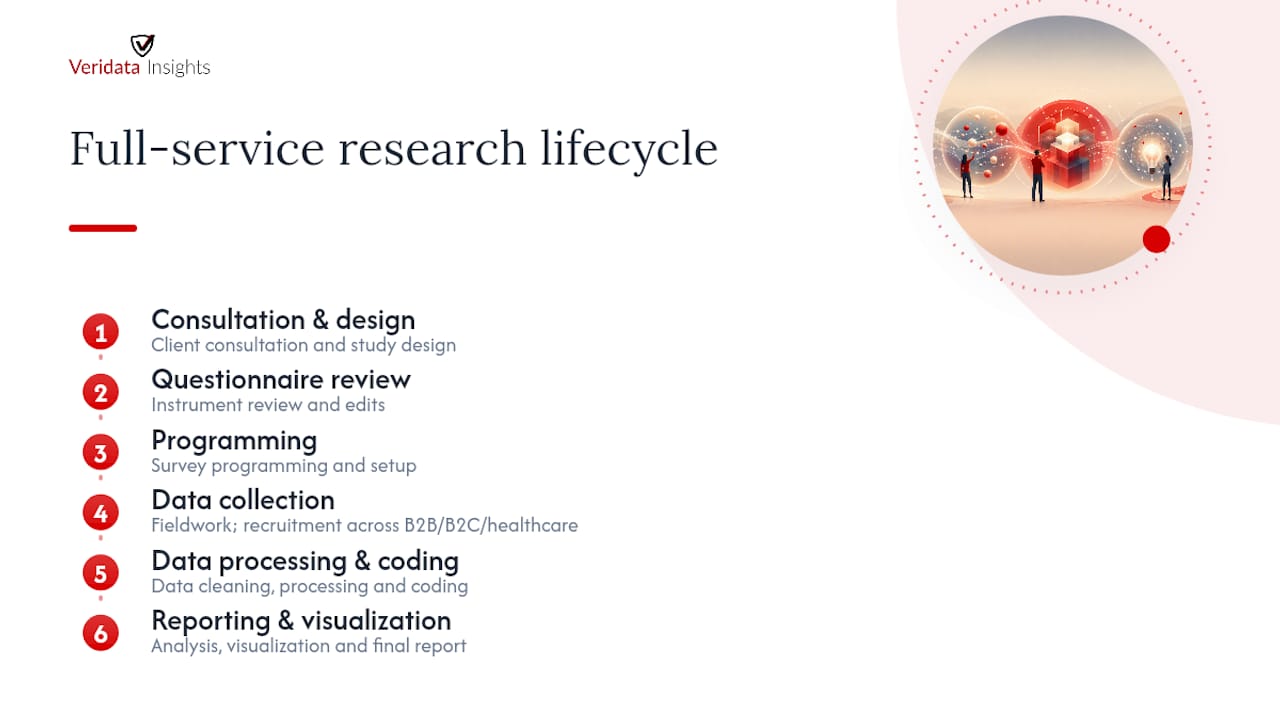
A full-service market research partnership covers the full project lifecycle: consultation and design, questionnaire review, programming, data collection, data processing and coding, and reporting with analytics and visualization. Some full-service research partners operate every day of the year, which matters when a client’s timeline doesn’t wait for a Monday.
Common value areas include hard-to-reach audience recruitment across B2B, B2C, and healthcare categories; integrated qualitative and quantitative designs under one methodology; and projects in regulated or specialized sectors where sample precision matters.
If you’re comparing us against another vendor, hold every provider’s published capabilities against your own RFP checklist. Ask each one to walk through their recruitment sourcing and screening the same way you’d ask us. A vendor that can answer specifically, not generically, is the one worth shortlisting.
Ready to Start an Outsourced Research Project?
If your team is weighing speed against expertise, or wrestling with a sample that’s proven hard to reach internally, that’s exactly the gap a full-service partner is built to close. A full-service partner can handle everything from questionnaire design through final visualization, sometimes with no project minimums standing between you and a properly fielded study. Before you finalize a scope, it’s worth comparing your requirements against how to choose a market research company so you know what to ask for. When you’re ready to move, request a proposal or a short discovery call and describe what you’re trying to learn. We’ll tell you plainly whether we’re the right fit, and what it would take to get you answers.
Sources
- Marketing Research: To Outsource or Not? | CASE
- Market Research Outsourcing Guide: 2026 Best Practices