

TL;DR:
- Effective government surveys rely on clear objectives, representative sampling, and thoughtful questionnaire design. Multi-channel outreach and active data monitoring enhance response rates and data quality. Building trust through engagement and research consistency leads to better insights and policy support.
Conducting government surveys is the systematic process of designing, distributing, and analyzing questionnaires to gather reliable public data that supports informed policy-making and service improvement. Done well, a government survey gives agencies, nonprofits, and academic researchers a direct line to the communities they serve. Done poorly, it wastes budget and produces data no one can act on. This guide walks you through every stage of the process, from setting clear objectives to cleaning your final dataset, using best practices for surveys grounded in current public sector research standards.
How to conduct government surveys: planning before you launch
The most expensive mistake in public sector research is launching before you are ready. Solid planning determines whether your data will hold up under scrutiny or fall apart at the analysis stage.

Start by writing a single, clear research objective. That objective should answer one question: what decision will this survey data inform? A city housing department, for example, might frame its objective as “identify barriers to affordable housing applications among residents earning below the area median income.” Every question you write later must connect back to that statement.
Once your objective is set, define your target population with precision. Government surveys often need to represent diverse demographic groups, including residents with limited English proficiency, older adults, and people without reliable internet access. Ignoring population diversity in access needs produces biased samples, which means you will need multiple engagement methods to achieve a representative dataset.
Key planning steps before launch:
- Define your research objective in one sentence tied to a specific policy or program decision.
- Identify your target population and document any subgroups that require special outreach.
- Determine your sample size based on the confidence level and margin of error your agency requires.
- Select your survey mode from online, telephone, in-person, or a mixed-method combination.
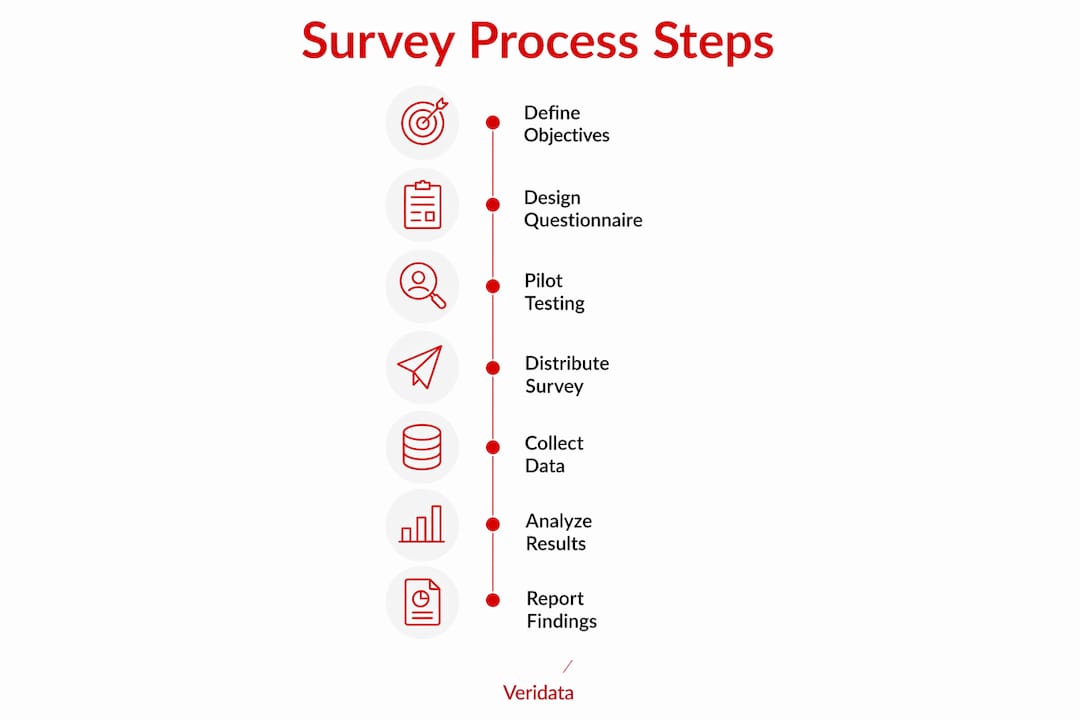
- Build a project timeline that includes design, pilot testing, distribution, and analysis phases.
Pro Tip: Run your pilot test on the actual devices and network conditions your respondents will use. Testing a mobile survey on public Wi-Fi catches issues that a desktop lab environment will never surface, and those issues are exactly what cause respondents to abandon mid-survey.
Pilot testing under realistic conditions is critical and frequently skipped. Skipping it is how agencies end up with invalid datasets that cannot support the policy decisions they were designed to inform.
How to design effective government survey questionnaires?
Questionnaire design is where most government surveys succeed or fail. The structure of your questions directly controls the quality of your data.
The first rule is that every question must map to a specific program or policy decision. Questions that lack a clear connection to your research objective dilute the dataset and waste respondents’ time. Before finalizing any question, ask: “What will we do differently based on the answer?” If you cannot answer that, cut the question.
Follow these steps to build a questionnaire that works:
- Write in plain language. Avoid agency acronyms, legal terminology, and technical jargon. If a 10th grader cannot understand the question, rewrite it.
- Use neutral phrasing. Leading questions bias responses. “How satisfied are you with our services?” is neutral. “How much has our service improved your experience?” is not.
- Order questions from general to specific. Start with broad, easy questions to build respondent momentum. Place sensitive or demographic questions at the end.
- Mix closed and open-ended formats strategically. Closed questions (multiple choice, Likert scales) produce quantifiable data. Open-ended questions capture nuance. Use open-ended formats sparingly to avoid respondent fatigue.
- Keep the survey as short as possible. Every unnecessary question increases drop-off risk. If your survey takes more than 10 minutes to complete, expect significantly lower completion rates.
Question order affects drop-off rates in measurable ways. Starting with harder or more sensitive questions causes respondents to abandon the survey before you collect the data you actually need. A conversational flow, moving from general to specific, keeps people engaged through to the final question.
Pro Tip: After writing your questionnaire, read it aloud from start to finish as if you are a first-time respondent. You will catch awkward phrasing, confusing transitions, and questions that assume knowledge your respondents may not have.
For a deeper look at questionnaire design principles that support policy decision-making, Veridata Insights has published practical guidance built around public sector research needs.
What are the best methods to distribute government surveys and maximize response rates?
Distribution strategy determines who responds, and who responds determines whether your data is representative. A well-designed survey sent through only one channel will almost always produce a skewed sample.
Multi-channel outreach is the standard for government survey methods. Community-tailored outreach using tablets at community markets, text-to-participate codes, social media ads, and in-person intercept surveys reaches populations that online-only distribution misses entirely. This matters most when your target population includes older adults, low-income households, or residents in areas with limited broadband access.
| Distribution channel | Best for | Key challenge |
|---|---|---|
| Online (email or web link) | Digitally connected populations | Excludes low-access groups |
| Telephone (IVR or live interviewer) | Older adults, rural residents | Higher cost per response |
| In-person intercept | Hard-to-reach or low-trust communities | Resource-intensive |
| Text-to-participate | Mobile-first populations | Requires opt-in lists |
| Mixed method | Broad, representative samples | Requires coordination across channels |
Incentives work. Gift cards and financial compensation improve response rates in government-level surveys, particularly for in-depth expert feedback or surveys targeting hard-to-reach demographics. The incentive does not need to be large. Even a modest reward signals that you value respondents’ time.
Key distribution tactics that drive participation:
- Communicate the purpose clearly. Explaining how feedback shapes policy transforms a survey from a form into an advocacy tool. Respondents who understand the impact of their answers are more likely to complete the survey.
- Set a minimum launch duration of seven days. Collecting responses over at least one week captures a broader demographic range and reduces timing-related bias caused by day-of-week effects.
- Send reminders at strategic intervals. A reminder at the midpoint of your launch window consistently lifts final response counts.
- Partner with trusted community organizations. Local nonprofits, libraries, and faith communities can distribute surveys to populations that distrust direct government outreach.
For more on engaging research respondents across channels, Veridata Insights covers incentive design and communication tactics in detail.
How to monitor, analyze, and ensure quality in government survey data?
Data collection does not run itself. Active monitoring during your launch window is what separates a clean dataset from one full of problems you discover only after the survey closes.
Track response rates by demographic segment from day one. If a particular group is underrepresented at the midpoint, you still have time to adjust your outreach. Send targeted reminders to channels that serve that group, or extend your launch window if the gap is significant.
Data cleaning is non-negotiable before analysis begins. Key quality steps include:
- Remove incomplete responses that fall below a minimum completion threshold (typically 50–80% of questions answered).
- Check for straight-lining, where respondents select the same answer for every Likert-scale question. This signals disengagement and produces unreliable data.
- Validate open-ended responses for relevance. Gibberish entries and off-topic text should be flagged and excluded.
- Cross-check demographic data against your known population parameters to identify sample imbalances.
- Apply weighting if certain demographic groups are over or underrepresented relative to the actual population.
Pro Tip: Build your analysis plan before you launch the survey, not after. Knowing exactly which cross-tabulations and comparisons you need will prevent you from collecting data you cannot use and missing data you actually need.
Once your data is clean, align your analysis directly with your original research objective. Every finding should answer the question your survey was designed to address. Findings that do not connect to your objective belong in an appendix, not the executive summary. Build in a feedback loop after each survey cycle so that lessons from this project improve the next one.
What common challenges arise in government surveys and how can researchers overcome them?
Government surveys face a specific set of recurring problems. Knowing them in advance lets you build solutions into your design rather than scrambling to fix them mid-launch.
Survey fatigue is real. Residents who receive multiple surveys from different agencies in a short period stop responding carefully, or stop responding at all. Coordinate with other departments before launching to avoid overlap, and keep your survey as short as your research objective allows.
Trust barriers affect participation in communities with historical reasons to distrust government data collection. Partnering with established community organizations, using plain-language consent language, and being transparent about data use and storage all help. Follow-up communication after survey closure is equally important. Treating surveys as one-time events misses the opportunity to build the ongoing trust that improves future participation.
Unanswerable questions are a silent killer. A question that sounds reasonable in a planning meeting may produce data that no one can act on. Every question must tie to a decision. If it does not, it should not be in the survey.
“Communicating the benefits respondents gain by participating increases engagement and survey completion rates.” This principle applies directly to government surveys, where respondents often need a clear reason to invest their time.
The step-by-step survey methodology framework from Veridata Insights addresses these challenges with structured guidance built for public affairs research contexts.
Key Takeaways
Effective government surveys require clear objectives, representative sampling, thoughtful questionnaire design, multi-channel distribution, and active data quality monitoring at every stage.
| Point | Details |
|---|---|
| Define objectives first | Every survey question must connect to a specific policy or program decision. |
| Pilot test under real conditions | Test on actual devices and networks to catch issues before full launch. |
| Use multi-channel distribution | Reach low-access populations through in-person, text, and community partner outreach. |
| Launch for at least seven days | A minimum seven-day window reduces timing bias and improves demographic coverage. |
| Build follow-up into the plan | Post-survey communication builds trust and improves participation in future surveys. |
What I have learned from watching government surveys succeed and fail
The surveys that produce genuinely useful data share one quality: the team behind them treated respondents as people, not data points. That sounds obvious. In practice, it is rare.
I have seen well-funded surveys collapse because the questionnaire was written by committee, with every department adding questions until the survey took 25 minutes to complete. Completion rates cratered. The data that came back was too thin to support any real analysis. The lesson is not subtle. Shorter surveys with sharper objectives outperform long surveys with vague ones every time.
The other pattern I keep seeing is agencies that launch a survey, collect the data, and then go silent. No summary of findings. No explanation of what changed as a result. Respondents notice. The next time that agency asks for their time, participation drops. Ongoing engagement after a survey closes is not a nice-to-have. It is the foundation of a research program that gets better over time.
Technology helps, but it is not the answer to a design problem. A mobile-friendly survey distributed through five channels still fails if the questions are confusing or the purpose is unclear. Get the fundamentals right first, then use technology to scale what works.
Veridata Insights: your partner for government survey projects
Veridata Insights works with government agencies, nonprofits, and academic researchers on every stage of the survey process. From survey consultation and design to programming, data collection, and reporting, the team brings full-service support with no project minimums. Whether you need help writing questionnaires that align with policy goals, setting up multi-channel distribution, or turning raw data into clear findings, Veridata Insights handles as much or as little as your project requires. The team is available seven days a week, 365 days a year. If you are planning a public sector survey and want expert support from day one, reach out to Veridata Insights directly.
FAQ
What is a government survey?
A government survey is a structured questionnaire used by public agencies, nonprofits, or academic researchers to collect data from residents or stakeholders that informs policy decisions and service improvements.
How long should a government survey stay open?
Collecting responses over a minimum of seven days helps capture a representative demographic range and reduces timing-related bias caused by day-of-week participation patterns.
How do you increase response rates in public sector surveys?
Use multi-channel distribution, offer modest incentives such as gift cards, communicate clearly how responses will shape policy, and send reminders at the midpoint of your launch window.
What is the biggest mistake in government survey design?
The most common error is writing questions that do not connect to a specific policy or program decision, which produces unfocused data that agencies cannot act on.
How do you handle hard-to-reach populations in government surveys?
Use community-tailored outreach methods such as in-person intercept surveys, text-to-participate codes, and partnerships with trusted local organizations to reach residents with limited digital access.