


TL;DR:
- A market analysis model is a structured process that combines research frameworks and competitive analysis to inform strategic decisions. Regularly updating competitor profiles and triangulating data improve the accuracy of market size estimates, leading to better business insights. Clear problem definition and balanced research methods prevent costly misdirection and enhance decision-making reliability.
A market analysis model is a structured process businesses use to gather, analyze, and interpret market data to make informed strategic decisions. The most recognized industry term for this practice is market analysis, though the phrase “market analysis model” captures the systematic, framework-driven nature of the work. At its core, every effective model combines two complementary disciplines: market research and competitive analysis, which together reveal where customer opportunities exist and how a business can differentiate itself. Frameworks like Porter’s Five Forces, SWOT, PESTEL, and market sizing tools such as TAM, SAM, and SOM give structure to what would otherwise be an overwhelming pile of raw data. The U.S. Small Business Administration and Harvard Business Review both treat these frameworks as foundational to sound business planning.
What are the essential frameworks used in market analysis?
The most widely applied market analysis frameworks each serve a distinct purpose. Knowing which one to use, and when, separates businesses that act on real intelligence from those that guess.

Porter’s Five Forces
Porter’s Five Forces assesses industry profitability by examining five competitive forces: competitive rivalry, threat of new entrants, bargaining power of suppliers, bargaining power of buyers, and threat of substitutes. Each force directly affects a company’s pricing power and profit margins. A market with high supplier bargaining power and intense rivalry, for example, compresses margins from both sides. This framework is best used when you need a clear picture of industry structure before entering a new market or launching a new product line.
SWOT and PESTEL
SWOT (Strengths, Weaknesses, Opportunities, Threats) works best as a synthesis tool. You run it after gathering data from other sources, not before. PESTEL (Political, Economic, Social, Technological, Environmental, Legal) maps the macro forces shaping a market. Use PESTEL early in your research to set context, then layer SWOT on top to connect external conditions to your internal capabilities.
Market sizing: TAM, SAM, and SOM
TAM, SAM, and SOM estimate the total revenue opportunity available in a market at three levels of specificity. TAM (Total Addressable Market) is the full market demand. SAM (Serviceable Addressable Market) narrows that to the segment your business model can realistically reach. SOM (Serviceable Obtainable Market) is the realistic share you can capture given your current resources and competition.
The table below shows when to apply each framework:
| Framework | Best used for | Key output |
|---|---|---|
| Porter’s Five Forces | Industry entry decisions | Competitive pressure map |
| SWOT | Strategic synthesis | Internal vs. external alignment |
| PESTEL | Macro environment scanning | Contextual risk and opportunity list |
| TAM, SAM, SOM | Market sizing and investment cases | Revenue potential estimates |
Triangulating TAM, SAM, and SOM with both top-down and bottom-up estimation methods guards against inflated projections. Cross-validating your assumptions increases model reliability and makes your business case far more credible to investors and leadership teams.
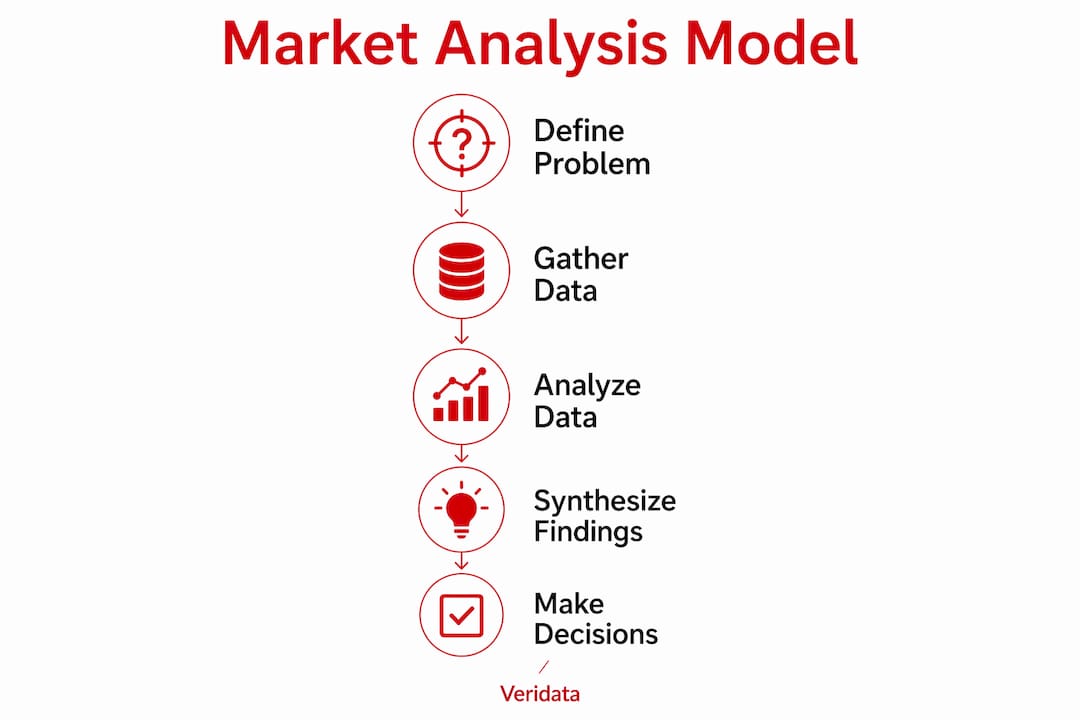
How is the market research process structured within a market analysis model?
A structured market analysis model follows a seven-step research process. Each step builds on the last, and skipping any one of them creates gaps that weaken your final conclusions.
- Define the problem and objectives. Clarify exactly what decision the research must inform. Vague questions produce vague answers.
- Develop the research design. Choose between exploratory, descriptive, or causal research depending on what you need to learn.
- Select information sources. Decide which combination of primary and secondary data will answer your research questions.
- Design data collection instruments. Build surveys, interview guides, or observation protocols that match your research design.
- Sample and collect data. Choose your sampling method and execute data collection with documented inclusion criteria.
- Analyze the data. Apply statistical or thematic analysis depending on whether your data is quantitative or qualitative.
- Communicate findings. Present results in a format that connects directly to the business decision at hand.
Precise problem definition is the most critical step. Vague research questions can cause an entire project to misdirect and miss the root market issue entirely. Define the decision first, then design the research around it.
Sampling methods and their implications
Probability sampling supports statistical generalization, meaning you can apply findings to the broader population with measurable confidence. Non-probability sampling prioritizes practicality and speed, which makes it useful for exploratory work but limits how broadly you can apply the results. Consumer studies typically use sample sizes in the range of 300–1,200 respondents for adequate precision. Documenting your sampling criteria and segment quotas is not optional. Stakeholders making investment decisions need to understand exactly who the data represents.
Qualitative vs. quantitative research
Quantitative research tells you what is happening; qualitative research tells you why. Surveys and A/B testing measure behavior at scale. Interviews and focus groups explain the motivations behind that behavior. The most reliable market analysis models use both, mapping each method to a specific decision rather than running them in parallel and hoping they agree.
Pro Tip: Before selecting a research method, write down the exact decision each data point will inform. If you cannot name the decision, you do not need that data point.
What are the best practices for competitive analysis within market analysis models?
Competitive analysis is not a one-time exercise. Markets shift, new players enter, and customer preferences evolve. A competitive analysis that was accurate 18 months ago may actively mislead you today.
The U.S. Small Business Administration recommends structuring competitor analysis by product line and market segment, not just by company name. This distinction matters because a business may face different competitors in different segments. A company selling project management software to small businesses competes against a completely different set of tools than when selling to enterprise clients.
Evaluate each competitor across these dimensions:
- Market share and growth trajectory. Is the competitor gaining or losing ground?
- Strengths and weaknesses. Where do they excel, and where do customers complain?
- Marketing and brand identity. What positioning do they own in the customer’s mind?
- Customer journey. How do customers find, evaluate, and buy from them?
- Barriers to entry they benefit from. Patents, switching costs, network effects, or exclusive supplier relationships.
- Indirect and secondary competitors. These are businesses solving the same customer problem with a different product or approach.
SWOT analysis works well as a synthesis tool after you have gathered competitor data. It forces you to connect external competitive findings to your own internal capabilities, which is where real strategic clarity comes from.
Pro Tip: Set a recurring calendar reminder every quarter to update your competitor profiles. Markets move faster than annual planning cycles.
For teams that want to go deeper, competitive intelligence methods offer structured approaches to benchmarking rivals and identifying gaps your business can fill.
How can businesses integrate market and competitive data for strategic decisions?
Raw data does not make decisions. Interpretation does. The goal of integrating market research and competitive analysis is to produce a clear, evidence-based recommendation that a leadership team can act on.
Market research and competitive analysis are mutually reinforcing. Market research surfaces customer needs and segment opportunities. Competitive analysis reveals which of those opportunities are already claimed and which remain open. Together, they define where a sustainable revenue model can be built.
Avoid these common integration pitfalls:
- Anecdote-driven conclusions. One customer interview does not represent a segment. Qualitative findings need quantitative validation before they drive major decisions.
- Ignoring contradictory data. When two data sources disagree, that tension is worth investigating, not smoothing over.
- Skipping triangulation. Combining qualitative and quantitative methods prevents single-source bias and produces more reliable insights.
- Misaligning findings to objectives. Every insight in your final report should connect back to a specific business decision defined at the start of the project.
Translating market data into recommendations requires contextualizing findings within your business’s specific constraints, not just reporting what the data shows. A market opportunity that requires $10 million in capital to capture is not an opportunity for a company with $500,000 in runway.
The market research process for consulting teams follows a similar integration logic, mapping each research output to a strategic recommendation rather than presenting data in isolation.
Key takeaways
The most effective market analysis model combines structured frameworks, disciplined research design, and continuous competitive monitoring to produce decisions grounded in evidence rather than assumption.
| Point | Details |
|---|---|
| Start with problem definition | Define the exact business decision the research must inform before selecting any framework or method. |
| Use frameworks for their purpose | Apply Porter’s Five Forces for industry entry, SWOT for synthesis, and TAM/SAM/SOM for sizing market opportunity. |
| Match methods to decisions | Use quantitative research to measure what is happening and qualitative research to explain why. |
| Triangulate your data | Cross-validate findings using at least two methods or sources to reduce bias and increase reliability. |
| Monitor competitors continuously | Update competitor profiles quarterly, not annually, to keep your analysis current as markets shift. |
What I have learned from years of watching market analysis go wrong
The most common failure I see is not a bad framework choice. It is a bad question. Teams spend weeks collecting data and then realize the research answered a question nobody actually needed answered. The root cause is almost always imprecise problem definition. The fix is simple but uncomfortable: slow down at the start and force the team to write the decision statement before touching a single survey or spreadsheet.
The second pattern I see constantly is the qualitative-quantitative imbalance. Organizations either run focus groups and treat every quote as gospel, or they run surveys and ignore the human context behind the numbers. Neither approach alone produces reliable intelligence. The businesses that get this right treat qualitative and quantitative research as two lenses on the same reality, not as competing methodologies.
Finally, competitive analysis tends to get treated as a project rather than a practice. Companies do a thorough competitor deep-dive for a product launch and then let those profiles sit untouched for two years. Markets do not wait. A competitor you dismissed as a minor player 18 months ago may now own the segment you were counting on. Build the monitoring habit, not just the initial report.
How Veridata Insights supports your market analysis work
Veridata Insights builds custom research programs that cover the full spectrum of market analysis, from framework selection and questionnaire design through data collection, coding, and reporting. Whether you need a focused competitive analysis or a full market sizing study, Veridata Insights works with no project minimums, seven days a week. The team specializes in B2B, B2C, healthcare, and hard-to-reach audiences, which means your data reflects the people who actually matter to your business. If you are ready to build a market analysis model grounded in quality data, reach out to Veridata Insights and get the research your decisions deserve.
FAQ
What is a market analysis model?
A market analysis model is a structured process for gathering, analyzing, and interpreting market data to support strategic business decisions. It typically combines market research frameworks like Porter’s Five Forces or SWOT with competitive analysis techniques.
What is the difference between TAM, SAM, and SOM?
TAM is the total market demand for a product or service, SAM is the portion your business model can realistically serve, and SOM is the share you can realistically capture given current resources and competition.
How many respondents do I need for a valid market research study?
Consumer studies typically use 300–1,200 respondents for adequate statistical precision. The right number depends on your sampling method, the size of the population, and the confidence level your decisions require.
When should I use qualitative vs. quantitative research?
Use quantitative research to measure what is happening at scale and qualitative research to explain why it is happening. The strongest market analysis models use both, mapping each method to a specific decision.
How often should competitive analysis be updated?
Competitive analysis should be updated at least quarterly. Markets shift faster than annual planning cycles, and outdated competitor profiles can lead to decisions based on conditions that no longer exist.