


TL;DR:
- Effective industrial market research follows a structured process to avoid missing critical insights.
- In 2026, emerging sectors like defense and data centers drive new growth opportunities beyond traditional industries.
Industrial market research is the systematic process of collecting, analyzing, and interpreting data about the industrial sector to support informed business decisions and strategic planning. Unlike consumer research, this discipline focuses on B2B dynamics, asset performance, supply chain behavior, and sector-specific economic signals. The stakes are high. Professionals who rely on outdated or poorly segmented data risk misreading markets worth trillions of dollars. This guide covers the core methodologies, the most critical 2026 trends, common pitfalls, and practical applications that turn raw data into real competitive advantage.
What are the essential steps in industrial market research?
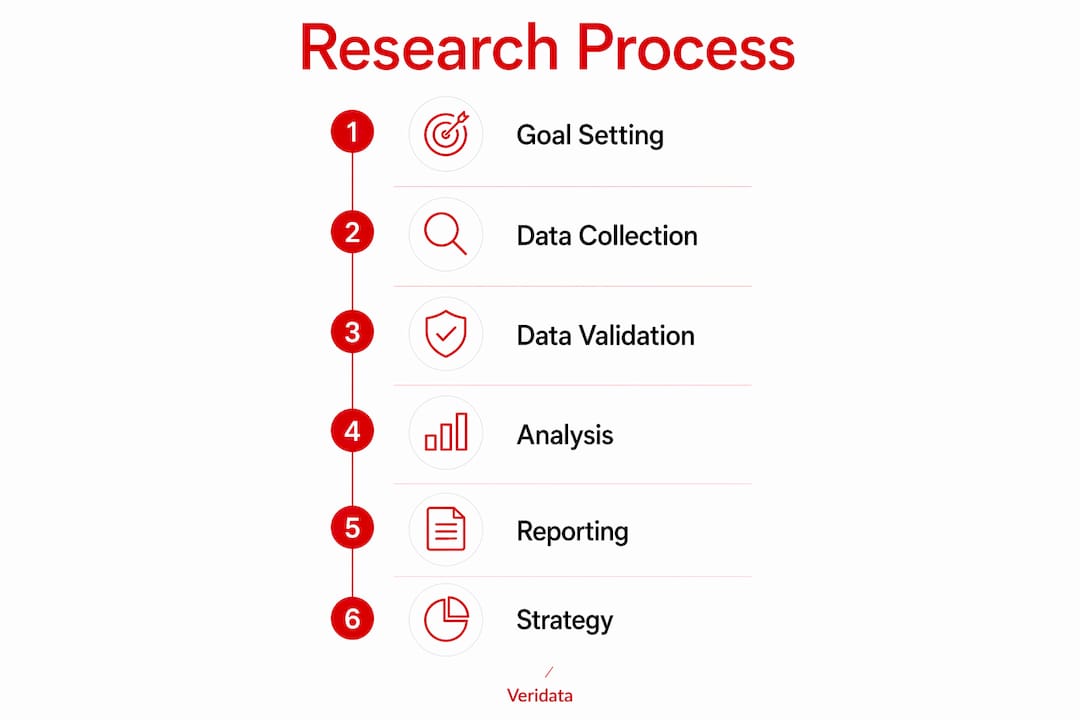
Effective industrial market research follows a 6–7 step process that begins with goal definition and ends with iterative planning. Skipping any step, especially audience segmentation, produces data that looks credible but answers the wrong question.
Here is the process that holds up in practice:
- Define your research goals. Be specific. “Understand logistics demand in the Southeast” beats “learn about the market.”
- Segment your audience. Identify whether you are studying manufacturers, logistics operators, real estate investors, or procurement teams. Each group needs different data.
- Choose your methods. Decide between primary research (surveys, interviews, observation) and secondary research (industry reports, government data, competitor filings).
- Collect data. Pull from multiple sources. Single-source data creates blind spots.
- Analyze and interpret. Look for patterns, outliers, and gaps. Numbers without context mislead.
- Validate your findings. Cross-check against independent sources before acting.
- Iterate. Markets shift. Build review cycles into your research plan from the start.
Primary research works best for specific business questions where no existing data fits. Secondary research, using sources like CBRE reports, U.S. Census Bureau data, and industry publications, provides general trends efficiently and at lower cost. Combining both approaches balances cost with depth of insight.
Pro Tip: Never rely on a single data source for industrial sector analysis. Cross-reference primary survey data with at least two secondary sources, such as government economic reports and sector-specific leasing data, before drawing conclusions.
Qualitative methods, including executive interviews and focus groups, surface the “why” behind the numbers. Quantitative methods, including structured surveys and transaction data analysis, confirm scale and direction. The strongest industrial research programs use both.
How do 2026 industrial market trends shape research priorities?
The 2026 industrial market is not behaving like a typical post-recession recovery. U.S. industrial leasing activity grew 14% year-over-year in Q1 2026, with megabox facilities over 1.2 million sq. ft. leading the charge. That growth signals a structural shift in demand, not just a cyclical bounce.

The national vacancy rate sits at 6.7%, while the construction pipeline grew 7.5% quarter-over-quarter. These two numbers together tell a nuanced story. Supply is catching up, but demand from large-format users remains strong enough to absorb it.
Earnings data reinforces the bullish picture. Industrial sector earnings are projected to grow 11.6% in 2026, following a 10.8% increase in 2025. The Materials sector projects even stronger growth at 25.3%. Researchers tracking these numbers should treat them as leading indicators for capital deployment, not just backward-looking performance metrics.
| Metric | 2025 | Q1 2026 |
|---|---|---|
| Industrial earnings growth | 10.8% | 11.6% projected |
| Materials sector earnings growth | Not disclosed | 25.3% projected |
| U.S. leasing activity (YoY) | Baseline | +14% |
| National vacancy rate | Higher | 6.7% |
| Construction pipeline (QoQ) | Baseline | +7.5% |
Three emerging sectors are rewriting the growth map. Defense, data centers, and infrastructure renewal are projected to become $1.1 trillion in new growth drivers by 2030, representing 37% of total industrial growth. Traditional growth pools, including general manufacturing and legacy logistics, are maturing. Research that ignores these emerging categories will miss where the real opportunity is building.
CFOs are shifting focus from cyclical management to structural transformation, with AI-driven asset optimization as the primary value lever. Permanent CapEx fiscal incentives are also spurring infrastructure investments that reshape industrial sector dynamics at a regional level. Any serious industrial sector analysis in 2026 must account for both.
What are the leading pitfalls to avoid in industrial research?
Industrial market research has a specific failure mode that consumer research does not. Many industrial segments simply lack public data, which forces researchers to rely on modeled estimates. Failing to distinguish modeled data from observed data leads directly to flawed strategic decisions. A number that looks authoritative in a report may be a regional estimate built on limited transaction samples.
The most common pitfalls professionals encounter include:
- Averaging across asset classes. Big-box facilities recover faster than older industrial stock. When you average vacancy and absorption rates across both, the result masks divergent performance. A market can look healthy in aggregate while older assets sit empty.
- Ignoring segmentation. Logistics, manufacturing, and flex industrial assets behave differently. Treating them as one category produces research that is technically accurate and practically useless.
- Over-relying on secondary data. Market research reports from CBRE, Newmark, and JLL are excellent starting points. They are not substitutes for primary research when your question is specific to a submarket or asset type.
- Skipping competitive analysis. Understanding where competitors are investing, and where they are pulling back, is as important as understanding demand fundamentals.
- Treating top-line figures as ground truth. Inflation, cited by 47% of industrial leaders as a top challenge, distorts nominal growth figures. Real performance requires inflation-adjusted analysis.
Pro Tip: When working with modeled data, always ask the provider how the model was built and what transaction volume underlies it. Thin transaction markets produce wide confidence intervals. Know the margin of error before you act on the number.
Avoiding these pitfalls is not about being cautious. It is about being right. The common pitfalls in market research that trip up consulting firms are well-documented, and most of them come down to insufficient segmentation and unvalidated data sources.
How does industrial research drive strategic business decisions?
Research findings only create value when they connect directly to decisions. Market research drives strategic decision-making in consulting by aligning insights with client-specific operational and investment challenges. The same principle applies inside any industrial company.
Here are the most impactful applications:
- Investment targeting. Vacancy rate trends and absorption data by submarket identify where to acquire, develop, or divest industrial assets before the broader market prices in the opportunity.
- CapEx planning. Earnings growth projections and CapEx incentive data help finance teams build capital allocation models grounded in sector reality rather than internal assumptions.
- Supply chain optimization. Leasing activity data reveals where logistics operators are concentrating, which signals shifts in distribution network geography that affect procurement and fulfillment costs.
- Product and service development. Primary research with industrial buyers uncovers unmet needs that secondary data cannot surface. This is where qualitative interviews earn their cost.
- Competitive positioning. Mapping competitor investments against emerging growth sectors, such as data centers and defense, reveals white space that a company can move into before competition intensifies.
Consulting clients expect research-driven strategies to be specific, segmented, and tied to measurable outcomes. Generic market overviews do not satisfy that expectation. The industrial professionals who get the most from their research build it into a continuous cycle, not a one-time project. Markets shift fast enough in 2026 that a research report from 18 months ago may already be structurally obsolete.
Flexible market research partnerships give consulting firms and corporate teams the agility to update their data as conditions change, rather than waiting for the next annual budget cycle to commission new work.
Key takeaways
Industrial market research produces reliable results only when methodology, segmentation, and data validation are treated as non-negotiable requirements, not optional steps.
| Point | Details |
|---|---|
| Follow a structured process | Use a 6–7 step research process from goal-setting through iterative review to avoid gaps. |
| Segment by asset class | Separate big-box, flex, and older industrial assets to avoid misleading averages. |
| Track 2026 structural shifts | Defense, data centers, and infrastructure are the growth sectors reshaping research priorities. |
| Validate modeled data | Always confirm the transaction volume and methodology behind any modeled regional estimate. |
| Connect research to decisions | Tie every finding to a specific investment, CapEx, supply chain, or competitive question. |
Why I think most industrial research misses the structural story
The biggest mistake I see in industrial market research is treating it like a snapshot. Teams pull a quarterly report, note the vacancy rate, and move on. That works fine in a stable market. It fails badly when the underlying structure of the sector is changing, which is exactly what is happening right now.
The shift from cyclical to structural trends in industrials is not subtle. Defense spending, data center buildout, and infrastructure renewal are not temporary demand spikes. They represent a fundamental reallocation of capital that will play out over a decade. If your research framework is built around tracking traditional absorption and leasing metrics, you are measuring the old game while the new one is already underway.
The AI integration story is equally underappreciated. CFOs are not just experimenting with AI tools. They are rebuilding asset optimization models around AI-generated signals. That changes what leading indicators matter. CapEx efficiency and AI adoption rates are now as relevant to industrial sector analysis as vacancy rates.
My honest recommendation is this: treat your research as a living system, not a deliverable. Build in quarterly data reviews. Separate your asset class tracking. And when you see modeled data, push back on the methodology before you trust the number. The professionals who do this consistently will make better calls than those who rely on top-line figures alone.
How Veridata Insights supports your industrial research needs
Veridata Insights works with business professionals and corporate researchers who need reliable, segmented data on industrial markets without the overhead of a large research department. Whether you need a focused quantitative study on a specific submarket or a full qualitative program with executive interviews, Veridata Insights handles every stage, from questionnaire design through data visualization and reporting. There are no project minimums, and the team is available seven days a week. If you are ready to build research that actually connects to your strategic decisions, contact Veridata Insights to discuss your next project.
FAQ
What is industrial market research?
Industrial market research is the systematic collection and analysis of data about the industrial sector, including manufacturing, logistics, and infrastructure, to support business strategy and investment decisions.
How do you conduct industrial sector analysis?
Start by defining a specific research goal, then combine primary methods like surveys and interviews with secondary sources like CBRE leasing data and government reports. Segment findings by asset class to avoid misleading averages.
What are the top industrial market trends in 2026?
U.S. industrial leasing activity grew 14% year-over-year in Q1 2026, and sector earnings are projected to grow 11.6% for the year. Defense, data centers, and infrastructure renewal are the fastest-growing demand categories.
Why does data segmentation matter in industrial research?
Big-box facilities and older industrial assets perform very differently. Averaging their vacancy and absorption rates produces figures that look stable while masking serious divergence between asset types.
How often should industrial market research be updated?
Quarterly updates are the minimum for active markets. Structural shifts in 2026, including AI adoption and CapEx incentive programs, are moving fast enough that annual research cycles leave significant blind spots.