

Many marketing analysts grapple with the gap between raw data and real understanding. Recognizing the difference between tracking a spike in product purchases and uncovering the motivations behind those numbers is the heart of consumer insight. Recent research highlights that consumer behavior involves not only rational choices but also emotional influences, psychological comfort, and context. Mastering this complexity will help your organization move beyond surface metrics and tap into the factors that truly drive customer decisions.
Table of Contents
- Defining Consumer Insight And Common Misconceptions
- Types Of Consumer Insight For Data-Driven Decisions
- How Consumer Insights Are Collected And Applied
- Making Insights Actionable In Global Markets
- Risks And Pitfalls In Using Consumer Insights
Key Takeaways
| Point | Details |
|---|---|
| Consumer Insight Understanding | Real consumer insight involves understanding the motivations and emotions behind purchasing decisions, not just transactional data. |
| Types of Insights | Integrating cognitive, emotional, and contextual insights provides a well-rounded view of consumer behavior for effective decision-making. |
| Data Collection Variety | Utilizing multiple data sources, including surveys and behavioral tracking, is crucial for a comprehensive understanding of consumer behavior. |
| Addressing Risks | Address common pitfalls such as data bias and privacy violations by implementing diverse data governance practices and regular audits. |
Defining Consumer Insight and Common Misconceptions
Consumer insight means understanding the “why” behind what your customers do, not just the “what.” It’s the difference between knowing that 67% of your audience purchased a product and understanding that they bought it because it solved a specific pain point they faced on Tuesday afternoons. Real consumer insight reveals the motivations, emotions, and contextual factors driving purchasing decisions.
Many analysts fall into the trap of oversimplifying consumer behavior. They assume people make rational, logical choices based solely on product features and pricing. This misses the complete picture. Recent consumer behavior research shows that decisions involve a complex interplay of rational thinking, emotional responses, psychological comfort, and situational context. Your customers aren’t spreadsheets. They’re humans navigating life.
Another common misconception separates product features from consumer experience. Many organizations still treat “what a product does” as separate from “how customers feel about it.” This is backwards. Consumer experiences differ fundamentally from product features, and understanding how consumers remember, process, and rationalize those experiences creates the real opportunity for competitive advantage.
Here’s what trips up corporate teams: they collect data about transactions but ignore the emotional journey. They measure clicks but miss the hesitation. They track conversions but overlook why someone abandoned their cart at the final step. True consumer insight requires investigating both the conscious decisions customers make and the unconscious factors influencing them.
The connection between data and insight matters more than most organizations realize. Raw data alone tells you what happened. Consumer insight explains why it happened and what it means for your strategy. Your job is connecting those dots, not just counting them.
Pro tip: Start mapping customer decision journeys by interviewing 8-10 of your most recent buyers directly, asking “why” at least three times for each major decision point, rather than relying solely on quantitative survey responses.
Types of Consumer Insight for Data-Driven Decisions
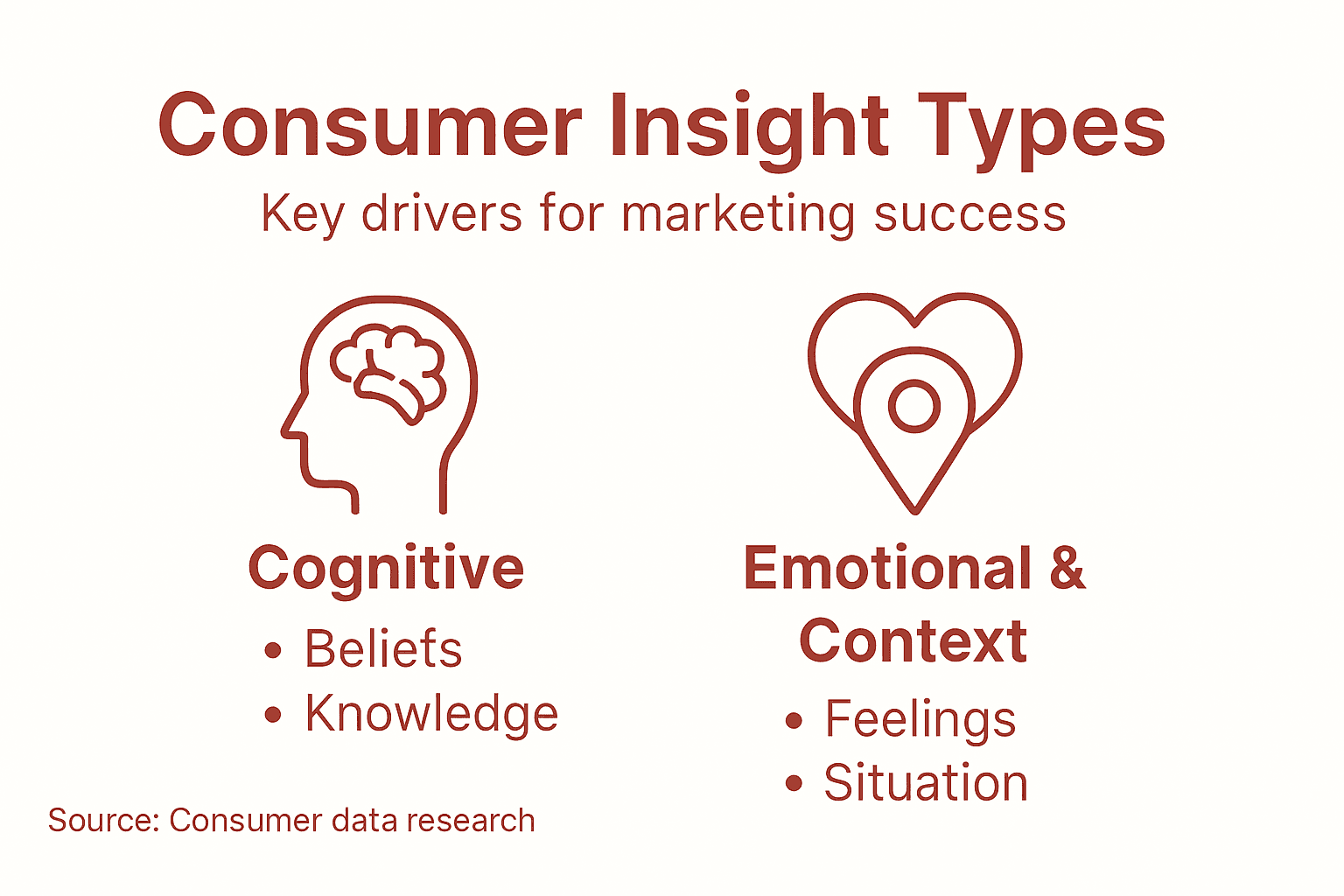
Consumer insights fall into three distinct categories, each revealing different aspects of buyer behavior. Cognitive insights capture rational decision-making processes. Emotional insights reveal how feelings drive choices. Contextual insights explain how situations and environments influence what people buy. Together, they form a complete picture of why consumers act the way they do.
Cognitive insights focus on how customers think and reason. These involve their knowledge, beliefs, and problem-solving approaches. When someone researches product reviews before purchasing, they’re operating in the cognitive domain. Your marketing data captures this when customers compare features, evaluate pricing, or read descriptions. Understanding consumer behavior theories helps you interpret what this rational thinking reveals about their needs and priorities.

Emotional insights dig deeper into what people feel about brands and products. A customer might rationally choose Product A but emotionally prefer Product B because it makes them feel confident or successful. These emotions shape loyalty, brand advocacy, and willingness to pay premium prices. They explain why someone buys an expensive coffee maker instead of a budget alternative, even when both brew coffee equally well.
Contextual insights examine how situations shape decisions. The same person buys differently when shopping alone versus with friends, when rushed versus leisurely, when stressed versus relaxed. Choice modeling approaches help you analyze revealed and stated preferences across different scenarios, revealing how context shifts customer behavior. This lets you predict how people will respond when conditions change.
Data-driven decisions require integrating all three types. You combine survey responses (stated preferences) with purchase behavior (revealed preferences) and contextual factors to anticipate customer actions across scenarios. This integration transforms raw behavioral data into actionable intelligence that actually predicts what customers will do next.
Here’s a summary of the three types of consumer insight and what each reveals:
| Insight Type | Main Focus | Key Business Value |
|---|---|---|
| Cognitive | Customer reasoning and logic | Reveals needs and priorities |
| Emotional | Feelings toward brands/products | Predicts loyalty and willingness to pay premium |
| Contextual | Situational buying influences | Enables adaptation to varied scenarios |
Pro tip: Segment your audience by cognitive style, emotional drivers, and typical contexts they encounter, then test messaging that resonates with each segment’s specific combination rather than using one-size-fits-all campaigns.
How Consumer Insights Are Collected and Applied
Collecting consumer insights requires multiple approaches working together. Surveys ask customers directly about preferences and behaviors. Transaction data reveals what people actually purchased. Behavioral tracking shows how they interact with your brand. Credit and financial data expose spending patterns and economic constraints. No single method captures the full picture, so smart organizations layer them together.
Surveys remain foundational for understanding stated preferences. They let you ask why customers chose your product over competitors, what frustrates them, and what they’d pay for improvements. But here’s the catch: what people say differs from what they do. Someone might claim they prioritize sustainability while their purchase history shows they always choose the cheapest option. Surveys capture intentions and perceptions; they don’t capture actual behavior.
Transaction and behavioral data tell a different story. When you analyze consumer credit reporting data, you see real financial decisions across borrowing, consumption, and credit access patterns. This data reveals spending velocity, category preferences, and how economic conditions shift purchasing. Link this with survey responses, and suddenly you understand the gap between what customers say and what they actually do.
Applying these insights means translating raw data into strategic decisions. Consumer research programs use rigorous analysis combined with longitudinal studies to improve products and policy. Your marketing team should do the same: identify patterns in how different customer segments respond to messaging, timing, and channels. Test hypotheses generated from the data before rolling out major campaigns.
The application phase is where most organizations stumble. They collect excellent data but fail to act on it decisively. Build processes that automatically flag insights demanding action: if 34% of your best customers churned within 90 days of a price increase, that’s actionable. If younger demographics engage 3 times more with video content, adjust your creative production accordingly.
Pro tip: Create a quarterly “insight audit” where you review which collected data points actually influenced decisions and which sat untouched, then reallocate resources toward collection methods that drive real strategic changes.
Making Insights Actionable in Global Markets
Transforming consumer insights into global action demands more than collecting data across multiple countries. It requires adapting your strategy to local market realities while maintaining strategic consistency. Your North American insight about price sensitivity doesn’t automatically translate to Southeast Asian markets. Cultural values, economic conditions, and competitive landscapes shift dramatically across regions.
The core challenge is balancing standardization with localization. Your core product strategy might stay consistent globally, but marketing strategies must adapt to local contexts through pricing adjustments, distribution channels, and promotional messaging. A premium positioning that works in German markets might fail in emerging economies where price sensitivity dominates. Your insights tell you what consumers want; local adaptation determines how you deliver it profitably.
Pricing strategy exemplifies this complexity. Insights might reveal that consumers in Market A value quality over price, while Market B chooses affordability. Your response cannot be identical across both. You adjust pricing, product features, or promotional intensity based on what the local data tells you. This requires real-time decision-making infrastructure that connects insights to pricing engines and inventory systems.
AI and automation accelerate actionability significantly. AI-driven applications enhance decision-making speed and precision by processing regional consumer behavior patterns instantly. Instead of waiting weeks for insights teams to analyze market data, AI flags regional anomalies and recommends tactical adjustments within hours. This enables your teams to respond when market windows are still open rather than after opportunities close.
Implementation requires organizational design changes. Create regional insight councils with authority to make localized decisions based on global frameworks. Give your teams in Tokyo, London, and São Paulo the autonomy to adjust messaging, test new products, and optimize pricing within guardrails set by corporate strategy. This distributes decision-making closer to customers while maintaining brand consistency.
Pro tip: Establish regional insight dashboards that compare performance metrics across markets simultaneously, highlighting which local decisions outperformed global averages so you can scale successful adaptations to other regions faster.
Risks and Pitfalls in Using Consumer Insights
Consumer insights drive powerful decisions, but they also create real dangers if mishandled. Biased data leads to biased decisions. Incomplete analysis masks critical context. Poor data governance opens doors to regulatory violations. Smart organizations acknowledge these risks explicitly and build safeguards around them rather than pretending they don’t exist.
Data bias represents the most insidious risk. Your historical data reflects past discrimination, market inequities, and demographic imbalances. If your dataset skews toward wealthy customers because lower-income consumers weren’t surveyed, your insights about “typical” buyers will systematically exclude an entire market segment. This bias compounds when you layer automated systems on top. AI applications in consumer insights introduce risks including biased information and manipulation that erode consumer autonomy. Your algorithm might optimize for engagement in ways that exploit psychological vulnerabilities rather than serve genuine customer needs.
Privacy violations create legal and reputational damage. When you build predictive consumer scores, you’re combining data points consumers often don’t know you’re collecting. Predictive scoring raises risks of privacy violations, bias, and inaccuracies that lead to unfair treatment without transparency or consumer control. Someone might be denied credit or targeted with exploitative offers based on a data profile they never consented to and cannot see.
Another pitfall surfaces when teams become overconfident in their insights. A pattern in data doesn’t prove causation. A demographic correlation doesn’t explain motivation. Insights teams sometimes mistake statistical significance for practical significance, recommending major strategy shifts based on marginal findings. And yes, I learned this the hard way when a 3% movement in a segment drove a complete product redesign that alienated the core customer base.
Lack of transparency compounds every risk. When consumer control over data use remains limited, customers can’t identify or challenge unfair treatment. Build internal processes that surface how insights are being applied and what assumptions drive decisions. Audit regularly for unintended consequences and demographic disparities.
Below are common pitfalls when using consumer insights and strategies to mitigate them:
| Pitfall | Potential Consequence | Recommended Prevention Method |
|---|---|---|
| Data bias | Exclusion of key segments | Ensure diverse and balanced data sources |
| Privacy violations | Legal or reputational risks | Establish robust data governance |
| Overconfidence in insight | Costly strategy errors | Validate with multiple data sources |
| Lack of transparency | Unfair or unchallengeable outcomes | Perform regular audits and disclose uses |
Pro tip: Before implementing any insight-driven decision affecting pricing, product access, or targeting, run a fairness audit checking how the decision impacts different demographic groups and income levels separately.
Unlock True Consumer Understanding to Drive Marketing Success
Struggling to turn raw data into actionable consumer insights that capture both emotional and contextual buyer motivations? Many marketers miss the crucial step of integrating cognitive, emotional, and situational factors into their strategies while navigating the risks of biased or incomplete data. At Veridata Insights, we specialize in global data collection and advanced market research tailored to reveal why your customers make decisions—not just what they buy. We help you uncover hidden pain points and emotional triggers that will power smarter, more human-centered marketing campaigns.
Don’t let valuable data sit unused or misunderstood. Empower your team with comprehensive consumer insight solutions that ensure transparency, privacy, and real-time adaptability across markets. Visit Veridata Insights today and see how our expertise transforms your raw statistics into strategic wins. Explore how we bring clarity to complex consumer journeys and deliver the competitive advantage your brand deserves.
Frequently Asked Questions
What is consumer insight and why is it important for marketing?
Consumer insight refers to understanding the motivations, emotions, and contextual factors behind consumer behaviors, going beyond just the data of what customers purchase. It is crucial for marketing as it allows businesses to tailor their strategies to meet the true needs and wants of their audience.
How can I collect effective consumer insights for my business?
To collect effective consumer insights, use a combination of surveys, transaction data, and behavioral tracking. Conduct interviews with customers to explore their decision-making processes, and analyze both stated preferences and actual purchase behaviors for a complete understanding.
What are the different types of consumer insights?
The three distinct types of consumer insights are cognitive insights (rational decision-making), emotional insights (feelings toward brands), and contextual insights (how situations influence buying decisions). Combining these insights helps create a more complete picture of consumer behavior.
How can organizations make consumer insights actionable?
Organizations can make consumer insights actionable by integrating data across different methods and applying findings to inform strategy. This includes adjusting marketing campaigns based on the insights while continuously validating the actions taken to ensure they resonate with target audiences.